Showing posts with label My articles. Show all posts

Monday, July 16, 2007

The Great River Theft


A plan to redirect water from the Himalayas is dire news for the mainland's neighbours, writes James Johnston


Visitors to Arunachal Pradesh - India's most northeastern state - cannot fail to be struck by the beauty of this largely unspoiled rural region which has borders with Bhutan, China's Tibet region and Myanmar. Through this countryside runs the mighty Brahmaputra, a life giver and provider for tribal fishermen and farmers who rely on the river's bounty and water.

Unfortunately, for the residents of Arunachal Pradesh the 21st century is intruding on their rural paradise.

For energy-hungry India, the potential hydropower of the river is too great to ignore. For the water-scarce regions of northern China, the river may help solve the problem of water scarcity plaguing its north and west. The river is called the Yarlung Tsangpo before it crosses from Tibet into India as the Dihang and then the Brahmaputra.

In fast-growing India, with a population of 1.1 billion, energy is badly needed. The interests of the million or so people in Arunachal Pradesh, most of whom live in close proximity to a river, are very much secondary.

However, an even greater threat to the livelihoods of the people of Arunachal Pradesh, not to mention those downstream in Bangladesh where the Brahmaputra becomes the Jamuna, is posed by Beijing's plans to exploit the upper reaches of the great river.

For the mainland, a rapidly expanding super-economy hungry for resources, finding adequate supplies of water is a matter of national urgency.

Whether it is to meet the energy needs of the largest population on Earth at 1.3 billion - the mainland has built more dams than any other country - or meeting the nation's food needs, where irrigation is used for over 70 per cent of food production, vast quantities of water are needed. But headlong development has come at the expense of water quality.

In China's arid north and west some 300 million people are short of water. And much of that available is heavily polluted.

At the highest levels the question is constantly being asked: where will the water come from?

"The central and local governments have all realised that water shortages have become a key constraint to the country's economic and social development," says Zhu Guangyao, deputy director of the State Environmental Protection Administration.

"There's growing tension among rural interests, urban interests and factories over who gets water in China," says Yukon Huang, a Singapore-based adviser to the World Bank. "Water will become a major problem for China in the next decade."

Beijing is looking to deal with the problem by means of a bumper solution.

One stage of the solution was completed in May last year, when the Three Gorges Dam on the Yangtze - 12 years in the making - had its final layer of concrete put in place. The dam, which has resulted in the displacement of around 1.4 million people, will be fully operational in 2009.

The completion of this monumental project is only one part of a much wider water strategy - the South-North Water Diversion Project. By 2050 engineers hope to move an estimated 45 billion cubic metres of water annually from south to north through an elaborate series of tunnels, aqueducts and canals.

Already half a million people have been relocated as engineers seek to link the country's major arteries: the Yellow River, Yangtze, Huaihe and Haihe. The scheme requires construction of three diversions in the eastern, central and western parts of the country at a cost roughly twice that of the Three Gorges Dam - somewhere in the region of US$62 billion.

It is not only mainlanders who will be affected by this wholesale realignment of the country's water arteries.

The geography of South Asia is such that every manipulation of a river by the mainland impacts on those downstream.

Tibet is known as the "Roof of the World" for good reason. It is the catchment area for 10 of the world's greatest rivers that flow through deep canyons into Asia like giant gutters after heavy rain, supplying almost half of the world's population.

Tampering with these vital waterways in an age of growing climate change awareness seems ludicrous, yet that is exactly what Beijing is proposing. Picture the Himalayan glaciers as a massive natural water tank. The mainland authorities wish to punch a great hole in that tank and siphon water away from its neighbours through a buried pipe no one seems to have noticed.

Work is well under way on two of the diversions: the central and eastern routes. The western route is an altogether more difficult proposition as it involves diverting water from the mightiest of Tibetan rivers, the Yarlung Tsangpo.

Since the late 1990s the mainland has been interested in exploiting the Yarlung Tsangpo. However, the river is not important to the mainland alone. For India's states of Arunachal Pradesh and Assam and Bangladesh, it is a vital water source. Its journey takes it through the Zangpo canyon, which contains the Tsangpo gorge: eight times steeper and three times larger than the Colorado in the Grand Canyon. At a sacred site the Tibetans call Pemako - the last hidden Shangri-La - the river makes a dramatic U-turn from east to west, flowing into India at The Great Bend. In just 200km the river descends 3,000 metres - the greatest hydropower potential in the world.

Following preliminary studies in 2003, the mainland's proposed plan - as outlined by the chief planner of the Academy of Engineering Physics, Professor Chen Chuanyu - would involve using nuclear explosives to blast a 15km tunnel through the Himalayas to build a dam capable of generating twice the power of the Three Gorges Dam. The hydropower potential would be sufficient to pump the river water 800km into the desert regions of northwest China, eventually linking with the Yellow River. This would fulfil the final third branch of the mainland's South-North Water Diversion Project.

The sheer effrontery of diverting a river of such importance to the mainland's neighbours has perhaps ensured the rest of the world remains sceptical that it will proceed.

"Man should intervene with nature and reorganise her for his purposes," Professor Chen has said. "With this project the drought in northwest China could be terminated and the flood catastrophes in Southeast Asia brought under control."

Some experts are not so confident. "The south-to-north project will alleviate shortages in China's northern plain, but it won't come close to solving them," says Eva Sternfeld, a Beijing-based director at the Environment and Sustainable Development Reference and Research Centre. "Water demand in northern China is just too huge."

Professor Chen plays down the effects of the project on southern neighbours, suggesting cheap electricity could be sold to India, Nepal and Bangladesh.

His words are unlikely to assuage the fears of those downstream. With the mainland's potential ability to turn the "taps" on or off, flood control takes on a far more sinister dimension. Control over Tibet's largest river is as great a political tool as any military force - like laying siege to an enemy fortress from the safety of your own home.

"China's green light for the [Yarlung Tsangpo] project could be considered by South Asia as a declaration of war," says Claude Apri, an Indian-based writer and journalist.

There is already a tense border dispute between the Tibet region and India. The McMahon Line, marking the border between Arunachal Pradesh and Tibet, has never formally been recognised by the mainland and military incursions are frequent. Last year, Sun Yuxi, the mainland's ambassador to India, declared: "In our position the whole of what you call the state of Arunachal Pradesh is Chinese territory ... we are claiming all of that."

The Indian response has so far been meek, perhaps daunted by the realisation that the mainland can quickly mobilise a force in the Himalayas by train and road access through a region India has barely explored on foot. "China seems intent on aggressively pursuing projects and employing water as a weapon," says Brahma Chellaney, professor of strategic studies at the privately funded Centre for Policy Research in New Delhi.

Beijing maintains that it would seek approval for any water diversion project. That remains to be seen.

In 2003 India denounced the plan to divert the northern source of the Brahmaputra, but it seems to have changed tack. New Delhi has now extended the velvet glove by backing plans to dam a section.

This payoff has been likened by one Tibetan publication to the Indian fable regarding a rural simpleton who chopped off a tree branch he was sitting on. It is unlikely that any of the rural locales in Tibet, Arunachal Pradesh, Assam or further downstream would support something so suicidal.

In any case, India has its own plans for exploiting the Brahmaputra and the communities along the river will pay the price.

They will be forcibly displaced from a river with which they have lived in harmony for as long as anyone can remember. Millions downstream in India and in Bangladesh are reliant on the river to provide vital soil sustenance and irrigation. They, too, will suffer.

And if India is not prepared to stand up to the mainland, then Bangladesh is up the proverbial creek without a paddle.

Maminul Haque Sarker of Bangladesh's Centre for Environmental and Geographic Information Services says the water flow of the Brahmaputra-Jamuna will decline by one-third if the project goes ahead.

"Around 15 to 20 small and medium-sized rivers including Dhaleshwari, Shitalakkha and Balu will die," he says, with devastating consequences for the country's agriculture and fishing industries.

Additional reporting by Bloomberg

(c) South China Morning Post

Sunday, June 17, 2007

We All Live Downstream

I just had this article accepted at the South China Morning Post. It will be run in their Sunday Agenda section on Sunday, July 15th.


Unfortunately they charge to view archived articles. It may appear on the website but I don't know yet. For now I will leave sections of the article here, and hopefully be able to provide a link once the SCMP has run it.

-------------------------


Ismail Serageldin, former Senior Vice President of World Bank: “The next World War will be over water.”

When rafting on the many tributaries that make up the Brahmaputra in Arunachal Pradesh – India's northeastern most state – I learned first hand that rivers are the economic and cultural backbone of South Asia. Journeying through that largely unspoiled rural region which is bordered on three sides by Bhutan, Chinese-controlled Tibet and Myanmar, I met the tribal fishermen and farmers who rely on the river's bounty and water, was witness to the natural beauty of the deep canyon of the Brahmaputra, and found myself enjoying the tribal Siang (Brahmaputra) river festival. The festival has become an annual event, unifying diverse and scattered tribes, linked through the life-giving and life-taking Siang river.

It was shocking to peacefully float down a river in a raft where the only signs of man are bamboo bridges, then to turn a corner and be faced by a gutted forest and mass construction. The Indian government are moving quickly to “develop” Arunachal as its potential hydropower is realised, and its scattered tribes can be damned. Governments appear to play a numbers game when it comes to displacing those who have lived by a river for generations. In fast-growing India, energy is needed for a population just over one billion. There are a million people in Arunachal, most of whom live in close proximity to a river.

The distribution, manipulation and pollution of river waters is creating mounting tension and displacing those downstream (and upstream) all over the world. Water is a matter of life and death.

When talking about water though, you have to consider China. One runs out of superlatives when describing China's energy and water crisis. Water is catastrophically scarce in a country that has built more dams than any other in the world in an attempt to provide energy for the largest population on earth. The little water that is available is heavily polluted. In the arid north and west some 300million people lack clean drinking water. Statisticians tremble at future pressures on the world food supply in the knowledge China uses irrigation for more than 70% of its food production. At the highest levels the question is asked: where will the water come from?

..................

The geography of South Asia is such that every manipulation of a river by the Chinese has a trickle-down effect. Tibet is known as ‘the roof of the world'. It's the watershed area for ten of the world’s greatest rivers that flow through deep canyons into Asia like giant gutters after heavy rain; feeding almost half of our entire planet’s population. Tampering with these vital waterways in an age of growing climate-change awareness seems ludicrous, yet this is exactly what the Chinese are proposing. Picture the Himalayan glaciers as a massive natural water tank for the world. China wishes to punch a great big hole in that tank and steal water away from its neighbours through a buried pipe no one seems to have noticed.

...........

Work is well underway on two of the diversions: the central and eastern routes. The western route is an altogether more difficult proposition as it involves diverting water from the mightiest of Tibetan Rivers, the Yarlung Tsangpo, some 800km from the mountainous Qinghai-Tibet Plateau.

Since the late 1990s there has been Chinese interest in harnessing the hydropower of the Yarlung Tsangpo – that becomes the Brahmaputra when flowing into India through Arunuchal Pradesh, then the Jamuna in Bangladesh; a water source vital to both countries. Its journey takes it through the Zangpo canyon, which in 1994 Chinese geologists announced was the biggest in the world. It contains the Tsangpo gorge: eight times steeper and three times larger than the Colorado in the Grand Canyon. Most importantly, at a sacred site the Tibetans call Pemako – the last hidden Shangri-La – the river makes a dramatic u-turn from east to west, moving into India at The Great Bend. In just 200km the river descends 3000m – the greatest hydropower potential anywhere in the world.


............

The sheer outrageousness of diverting such an important river has perhaps ensured the rest of the world remains sceptical. They should start listening. For China it is never a question of 'Should we...?' but always 'How do we...?' Chanyu has proclaimed: “Man should intervene with Nature and reorganize her for his purposes. With this project the drought in Northwest China could be terminated and the flood catastrophes in Southeast Asia brought under control.” He also suggests cheap electricity could be sold to India, Nepal and Bangladesh
.


His words are unlikely to assuage fears for those downstream. With China’s potential ability to turn the taps, as it were, on or off, flood control can take on far more sinister qualities. Control over Tibet's largest river is as great a political tool as any military prowess – like laying siege to an enemy fortress from the safety of your own home. Claude Apri, an Indian based writer and journalist, has said: “China’s green light for the [Yarlung Tsangpo] project could be considered by South Asia as a declaration of war.”

...................

South Asia’s river network is a manmade mess of diversions and reservoirs; the pollution levels unsustainable. But International Rivers Network campaign director Aviva Imhof has not given up hope. If there is a coordinated and concentrated effort to harness alternative power sources and efforts are made to clean up the water then the rivers are salvageable. “It doesn’t take as long as you would think to restore a river,” she has said. “There have been a lot of dam removal projects in the US and the river has returned to life in a very short space of time, sometimes as short as five to ten years.”

China continues to seek large-scale structural solutions to its growing energy and water crisis, but no matter how great their achievements, the crisis only seems to deepen. The tentative schedule for the initiation of the western component of the North to South Diversion Project has always been 2009, the year the Three Gorges Dam is to be fully operational. China has denied the project at various intervals in the past, but after the Grand Canal, the Great Wall, Mao’s Great Leap Forward and The Three Gorges Dam, it seems futile to deny the possibility of the 'Great Bend Diversion'. We must avoid yet another footnote in our damning history.

Wednesday, October 18, 2006

Burning Man

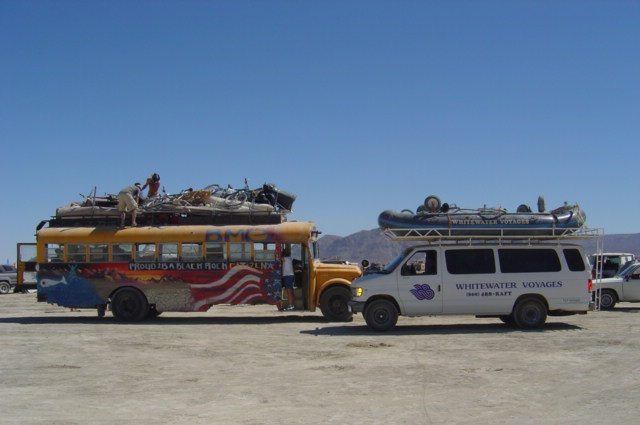
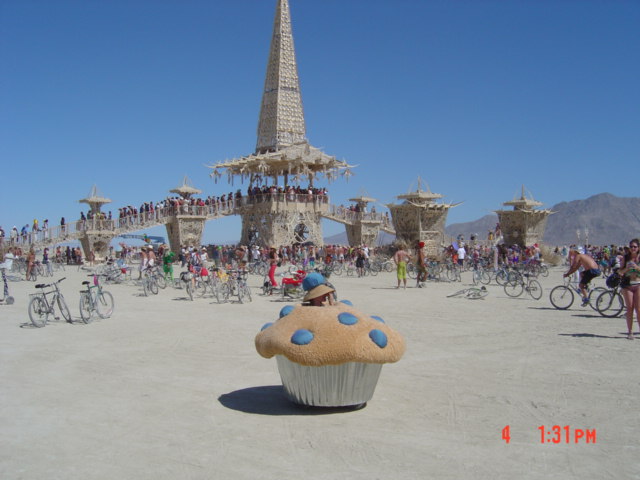
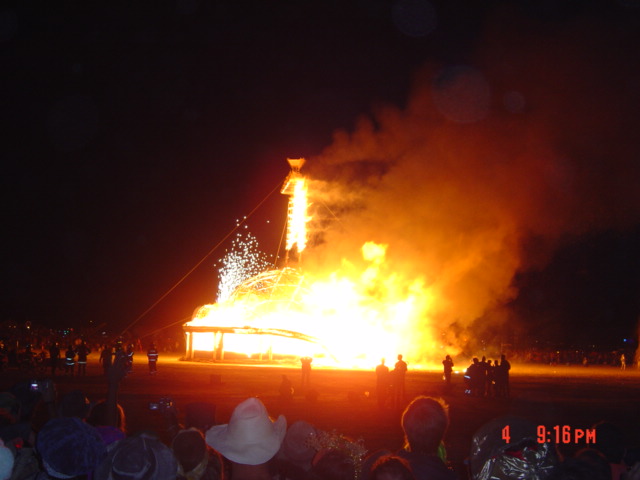
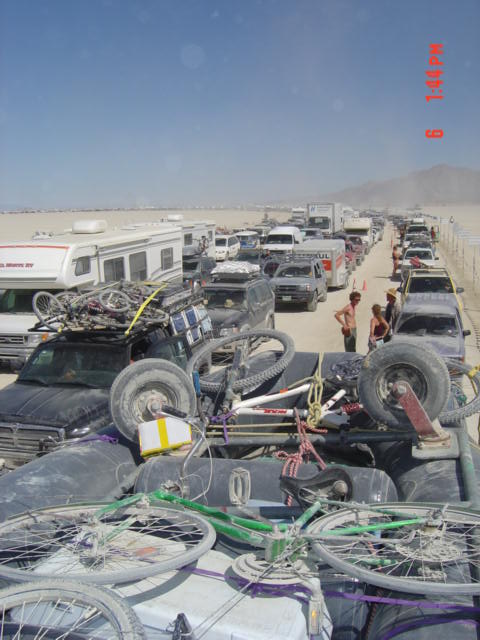
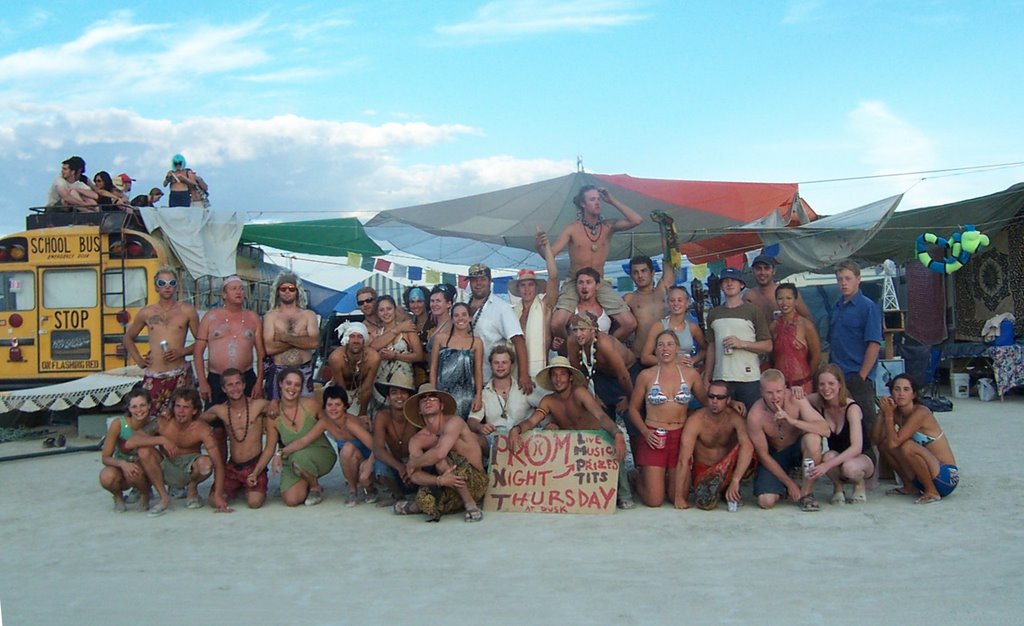
My friend, Brook Buswell, who took me under his wing for the two years I spent at Burning Man in the Nevada desert, recently sent me a reflection of his time at the free form arts festival that finished last month. It reminded me that I hadn't included the article I had published in The Herald Magazine on this blog. So here it is, in all its fiery glory. The pictures (except the last, which has me in the front row, 3rd from right) are all courtesy of my river-guide colleagues, Jasmine Jackson and Iain Morris, who managed to persuade the owner of our company, Whitewater Voyages, that taking a company van and raft would help sales of trips. Marvellous.


The Herald Magazine: Burn Baby Burn!
by Jamie M Johnston

My friend, wearing Stetson, flip-flops, shorts, goggles and with painted chest, turns to me and says, “Let’s get on the Dragon Bus.” “Where does it go?” I ask naively. “I have no idea,” was the suitably vague reply.

Five minutes later the driver of the Dragon Bus, an eighty foot construct of wheels and trailers fronted with a steam train and seats for one hundred crazies, looks back at me cross-eyed and screams, “Your not in Scotland now!”

We pull away from the dance tents, and streams of bikers, performance artists and scantily clad hippies, moving quickly into the desert. The wind whips dust into my army surplus goggles and I hold my hand tight over a cool Tanqueray and tonic. Spotting what looks like a tank I watch in fascination as it shoots flame high above the dust into the clear starry sky. Is this Madmax, or perhaps Fear and Loathing in Las Vegas?

Neither, it is Burning Man, the annual free-form arts festival founded by Larry Harvey that began as a beach party in San Francisco back in 1986 with the burning of a small wooden figure and has quickly become the event in America.

It springs up out of the desert floor and, in a bursting ball of flame, just as quickly turns to ash to merge with the clouds of dust that swirl and rage indiscriminately across this lunar landscape.

For one week only Black Rock City becomes the third biggest city in Nevada with figures of around 30,000 in attendance. It is situated some 120 miles northeast of the gambling, strip club, neon lighted Reno where most stock up on supplies for the week.

Enjoyment of the art, the people and the music can only be truly appreciated if one has arrived dutifully prepared with food, water and good accommodation. As my grandmother always said, “Recharging of the batteries is essential for a week long hedonistic festival.”


The best information to be found on the event is at www.burningman.com. The site comes fully loaded with essays, pictures, ideas and documentation of previous Burning Man festivals.

For outsiders who see Burning Man as a hippy fest of long hair, little amount of clothes, and pagan like dancing around huge bonfires, the incorporation of up to date technology in the art and in the running of the festival may come as a shock.

The ethos at work, according to the site, is that “Burning Man is an annual experiment in temporary community dedicated to radical self-expression and radical self-reliance.” This covers the main three areas at work in Burning Man.

The first, temporary community, means that one has to stay and immerse one’s self in the event. Here you can only be a participant. There are no spectators. Signalling this is the fact there are no day passes sold or discounts offered for partial duration.

To feel the true essence you have to become part of the community that is based on giving and sharing where you need and rely on others whom, in turn, need and rely upon you.

Larry Harvey’s comments on the shift in the media’s coverage of the event in an interview with Darryl Van Rhey from 1998 also highlight this idea of inclusion.

“…..they had to come, camp, live and survive among us. They had no choice but to immerse themselves in the story. This is radical inclusion – very Burning Man … as actual citizens of our city, they realized that our talk about community betokens something real.”

Secondly there is radical self-expression. Every year is themed and this year’s was the Vault of Heaven. But Black Rock City is a semicircle of smaller themed camps created by the citizens themselves.

They ranged from a car with tent that offered a chance to throw darts at pictures of the Royal Family (hugely popular) to a giant canopy with living quarters for twenty boasting a Full Contact Croquet League.

The atmosphere changes with your location. If you want madness go and fight your friend in the recreated Thunderdome, or chat amicably with strangers in centre camp, or dance like a madman at Disturbia, or simply stare at the sky peacefully in The Mausoleum with 360-degree alien desert noises.

No money is made from the festival. People are stripped of their creature comforts and normal social boundaries are left back in Reno. People wander freely completely naked, or paint themselves blue. Some come in their RVs. Some have a tent. But everyone becomes equal due to the saturation by the playa dust that gets in your food, in your bed and sooner or later, into every orifice.

Lastly there is “radical self-reliance”, or more aptly, survival. The only items one can buy are coffee and ice. Anything else you require must be bartered for from the other citizens. There is no legal tender or corporate sponsorships. If you want a drink, drugs, food or a hat then you must offer something in return.

To come unprepared is suicide. Sure you can swap a few things for some food and water. But who do you call on when it is 107 degrees and you have no shade, when the wind picks up to 70mph and your tarp whisks off into the sky, or when during the night the temperature plummets and your shorts and t-shirt are no longer adequate.

There is a reason for Burning Man being situated where it is. Here the elements are harsh and unforgiving. One has to look after one’s self and then look to the fellow man. There is no vending. The community shares and thrives.

To get around this vast 400 square mile dried up riverbed one should really bring a bike, moped, or trumped up lawn mower. My only brush with authority came when riding my moped. Unbeknown to me vehicles can only be used if they are licensed art vehicles. So after a facelift for my moped I went to the local DMV – the Department of Mutant Vehicles – to register my new vehicle.

To be honest this is the only kind of pressure to be found at Burning Man. The need to conform to nonconformity. You are not normal, or part of the crowd, unless abnormal. Funny then that Harvey, the founder, struts around with shades, trademark Stetson, shirt and jeans. He comments on his attire, “I’ve hated going along with the crowd all my life.”

As with any major contemporary festival drugs are rife and easy to get hold of. However, with so much man made visual stimuli on offer suffused with the natural dramatic backdrop of open desert and clear sky a natural high pervades the mood.

This is not a gathering dictated by the drugs on offer. This is Burning Man. Where a mist of mellowness, slow watchfulness and fascination sweeps over all. Life is brash, bright and loud, but equally slow and cautious. Burning Man is an altered reality that is literally burned to the ground after a week. Looking back it feels like you were hallucinating. But for me drugs had absolutely nothing to do with it.

Multitudes of workers and helpers arrive and leave sometimes months before and after the thousands of Black Rock citizens. Although the festival proper begins on a Monday and climaxes on the Saturday night with the burning of The Man, a forty-foot wooden construct atop an altar that towers above it all.

The climax approaches. Out in the playa the citizens gather around The Man. We are treated to a spectacular fire show with various Mad Max-like vehicles shooting balls of multicoloured flame at The Man and leather-clad fire-dancers spinning poi to a hypnotic drum beat.

With a full moon competing for attention the crowd chants “Run Burning Man Run”, until the whole neon effigy becomes a giant bonfire. As The Man collapses to the ground, the crowd rushes in screaming to dance madly around the white-hot embers, throwing in material possessions and things of sentimental value.

For the rest of the evening the citizens waltz from one fire-show to the next. The art projects dotted around the playa, carefully laboured on for the best part of a year, are quickly burned to the ground. When I saw a hundred foot matchstick-made cathedral go up, it burned so white it felt like my eyeballs would melt.

Fresh ideas and new beginnings are the name of the game.

This year’s theme asked a few questions: Where does everything come from? Where does everything go? And where and how, in this vast scheme of things, do we fit in? While sitting in a field of flapping flags with nothing else in sight I plucked up the courage for one brief moment – I’m British – to strip off and sit and contemplate my existence like Hugh MacDiarmid on his raised beach, or more aptly, Rilke in the Arabian desert.

Although Black Rock City disappears physically every year, people never leave quite the same. Everyone is talking a little piece of Burning Man back to his or her prospective realities. The Burning Man website acts as a gateway into the ever growing matrix of sites created by participants over the years who wish to prolong the reality at work in Black Rock City.

Along with this we now have Danger Ranger’s journey through America that is being documented on the website. This “Mystic Shaman Cowboy” has a mission to cut short the anxiety felt by the citizens of Black Rock after the Burning Man event when they realise that they have another 358 days to wait until the community is reunited once again.

“Danger’s message to you is that you need no longer wait. Take what you have learned from your experience, organize with friends and fellow burners, and be ready to greet him.”

The temporary community is slowly finding ways to elongate itself and prolong the reality at work in Burning Man. The message is clear, “Burning Man is not an event, but a new way of doing and being wherever you are. It is a movement, a force, a river: a culture with a thousand tributary streams.” This festival in the desert acts as a reminder. That life is only what you make it. With the global terrorism crisis our generation seems set to endure over the coming years, who says that the Burning Man mantra does not have a place in our world?

Friday, September 15, 2006

The Voluntourists, by Jamie M Johnston


Issue 14: Eco Adventures

Jul / Aug 2006
Lifestyle and Travel Magazine

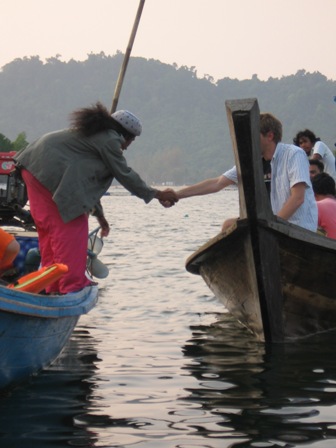
Pictures courtesy of North Andaman Tsunami Relief

Before Jamie M. Johnston set off for Thailand, he and his wife researched possible destinations
using internet search keywords like ‘responsible travel’, ‘eco-friendly’ and ‘sustainable tourism’.

They knew that ecotourism has a lot of potential for developing countries that boast a broad range of unique and pristine natural features. They found a lot more than they bargained for.

Some of the first areas to develop ecotourism – such as Kenya, the Galapagos Islands and Thailand – have already greatly suffered from weak development controls and ever increasing numbers of tourists. My wife and I arrived in Bangkok pragmatic, yet hopeful for some real cultural and adventurous experiences.

After a spell up north, and a disappointing introduction to the south, we made our way to Khao Sok National Park, which in turn led us to the small town of Kuraburi – a popular rest stop for those heading to the Marine National Park of Koh Surin. From there we visited Golden Buddha Beach, an eco-resort with a resident Sea Turtle Conservation project on the stunning small island of Koh Phra Thong. We strolled hand in hand, along kilometre after kilometre of untouched, pristine, golden beach with a fiery red and orange sunset painting the distant rain clouds, not another tourist in sight – an experience that was becoming difficult to envision in southern Thailand.

But there we were also witness to the lingering effects of the devastating Indian Ocean tsunami. This was no popular tourist destination like Phuket or Khao Lak; there had been no large corporate-funded rapid rebuilding here.

Instead, almost a year later, there were still uprooted trees, half-standing buildings and debris everywhere. Despite that, Golden Buddha had dusted itself off and done its best to reopen the doors not washed away. The rain and unchecked view out across the Andaman Sea took on a more haunted quality.

Within minutes we had fallen in love with the area, to the degree that we decided to stay and teach English with the pioneering group, North Andaman Tsunami Relief (NATR): a grassroots organisation born out of Golden Buddha Beach by Bodhi Garrett, an employee who was home in America during the tsunami. He was moved to action when Koh Phra Thong and its neighbouring coastal villages were largely overlooked in the relief efforts.

Mustafa, a local guide, teacher and environmentalist told me how overblown the aid had been in terms of construction of boats and houses. As he so succinctly said, “You can’t put your name on education, but you can put your name on a boat or a house.”

At NATR, at which we are now volunteering, we quickly learned that all the qualities that had attracted us to the area could also be its undoing. With the cultural diversity of traditional Buddhist, Muslim and Moken communities living alongside one another, a largely undeveloped coastline, plenty of rare and abundant wildlife and some of the oldest jungle terrain in the world, the area is ripe for an ever-expanding tourism market. Yet as tourism becomes a more prominent economic force in the area, there is a danger of local communities being unprepared, both in terms of job skills and cultural resilience. This could lead to rapid community, and natural, degradation.

NATR works with the coastal communities of the Kuraburi and Suksamran Districts (Phang-Nga and Ranong provinces, respectively) to facilitate a long-term strategy for development. The difference is that “development”, when NATR uses the term, is about sustainable livelihoods, vocational training, education, and income-generating projects. NATR has also been exploring the potential of Community-Based Tourism (CBT) by setting up pilot homestay tours in the tsunami-affected villages they serve – a cultural exchange where tourists stay with a local family and participate in traditional forms of livelihood and custom. CBT ensures the community’s unique heritage isn’t degraded and, with the extra income from small numbers of visitors, is instead allowed to flourish.

So what can you expect on a CBT home-stay tour? Well, I had my first experience of one in the village Ban Pak Triam (population: 119). Their pre-tsunami village was on a peninsula surrounded by mangroves and accessible only by boat. After the waters of the tsunami washed right over it, sweeping all 50 homes away and claiming the lives of two children, the peninsula became a small deserted island. Now the village has been relocated to the mainland and is closer to the markets and schools – a trade-off the community seems largely happy with. Upon arrival we were greeted by our Muslim English-speaking guide, Mustafa, and the unique whooping sound of Gibbon calls from the surrounding jungle. Mustafa is not a resident of the village, but he possesses intimate knowledge of the community and, through translation, gave a voice to the villagers who followed our progress eagerly. He took us to our home-stay to meet the woman who had opened her doors for six strangers.

Ma Da, like the majority of residents, lives in a sparse and small two-storey house. The floors are tiled and pictures of the King adorn the walls. She explained, through Mustafa, that the village as a whole had accepted the idea of CBT but that only a minority was actively participating. She said CBT wasn’t the sole answer to providing for her family’s long-term future, but rather one more small way of eking a living alongside other means. All this reinforced the importance to us of how CBT ‘fits’ into the communities’ lives, not the other way round. Mustafa reminded us that livelihoods remain based upon traditional methods, such as cashew nut harvesting, fishing and rubber tapping. But the pressures of progress are having a detrimental effect. Intensive commercial fishing and large-scale shrimp farms are lowering fish stocks and driving market prices down. There is, in fact, very little economic diversity in the area and slowly, year by year, most of the young, talented people leave the village to find work in larger cities. Mustafa was keen to point out that CBT gives the villagers the opportunity to manage tourism on their own terms and, vitally, in their own time.

We were then led to the community centre where a group of women run a tie-dye collective. We participated in ‘tying’ the material with elastic bands to create the patterns and saw how the material is then boiled in natural dyes: rhododendron flowers for a light purple, and turmeric for a sharp yellow. From there, our itinerary said: ‘12pm to 2pm relax’ – so we did.

In the afternoon we high-tailed it on a long-tail boat with one of the local fishermen, known as Superman. Donning a mask and grabbing a spear he slipped into the water and splashed around to attract his prey, emerging victorious on more than one occasion. Mustafa explained he was diving to his traps. They had no float or means of locating them. Superman just remembered where they all were, and in this way they could not be stolen or tampered with.

We visited a krachang – floating fish farm – further inland amongst the mangroves. Each mesh tank became a frenzy of fins, teeth and writhing bodies when the farmer threw in scraps of food. He fattens red snapper, grouper, tarpon, barramundi and even a few lion fish for the markets and exports to places like Japan and Malaysia. Have I mentioned the food yet? At mealtimes, we were bombarded with sweetmilk curries, fresh seafood, eggs, organic vegetables and the obligatory white rice. (As this was a Muslim village, there was no alcohol or pork.)

For the grand finale we went back to sea with a larger crew for a few hours of night fishing. Blessed with a threequarters moon, twinkling stars and a fairly sedate swell we chatted, dropped our prawn-baited hooks and learnt quickly that there really is a method to line fishing. The next morning, before we were allowed to leave, we were given coffee, sticky rice, roti and Chinese doughnuts.

For now, NATR is facilitating the outreach for tourists to the villages. We’ve had individuals and entire families come and sample a multi-day tour of multiple villages. Our experience had us in agreement that for a successful CBT, you need a specific type of tourist – the ‘voluntourist’: one who wants to respect and observe customs and experience culture first hand. Long-term voluntourists may stay for weeks, enjoying the same fun activities but also taking part in community-based projects like day-care, English lessons and construction. But the truth is that NATR will only complete its work when it can withdraw fully from the various projects it has set up.

To faciliate this, NATR began a six-month training program last April for 25 carefully selected locals who are motivated to participate in vocational training focusing on Adventure-, Community-, and Eco- (ACE) tourism – the ACE Expert team. This core group will help to lay the foundations for successful community-driven tourism in their villages.

Trip Information:
Trips can be customised around various activities and any group size catered for. As well as the fishing, tie-dye and Krachang mentioned here, there are also opportunities to harvest and roast cashew-nuts, visit a Gibbon sanctuary, help in mangrove restoration, explore how natural rubber is made and participate in other handicraft ventures like card- or soap-making. For the adventurous, there are canoeing, trekking, biking and snorkelling opportunities. Generally, trips are three days long and the price – depending on activities but including food, accommodation, and transfers – for a group of four people, averages USD 38 (Baht 1,500) per person, per day, with an English speaking guide.

North Andaman Tsunami Relief
Tel: +66 (0) 1 787 7344
relieffund@inet.co.th