Monday, December 11, 2006

Golden Age Rage


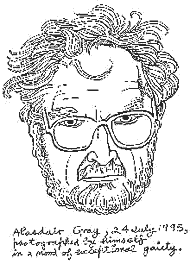
During my first year of study for the M.Litt in Creative Writing at Glasgow University the programme was run by the giants of Scottish Literature James Kelman, Alasdair Gray and Tom Leonard. It was a year of humbling and wonder.


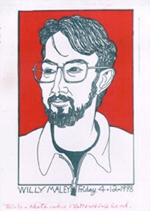
The following year Professor Willy Maley returned from a sabbatical and immediately there was a wind of change. He is an exciting and excited character, deliciously interested in literature. I remember him bubbling with enthusiasm as he let slip the title to a recent piece of literary criticism he had written: From T.S Elliot to Missy Elliot. He brought a much greater sense of possibility to me. Rooting writing firmly in whatever context or background one may find themself in.

Below is a sample of the way Willy Mayley's debates soon descend and swoop.


‘Golden Age Rage: Is the Claimed Renaissance in Scottish Literature Real?’, (an exchange of views between Stuart Kelly, Literary Editor of Scotland on Sunday, and Willy Maley), Product: Over the Counter Culture 11, The Modern Myths Issue (Winter 2006-7), pp. 36-41, ISSN 1468-9901.


“In a small country, the nest of genius is well hidden” (Dubravka Ugresic).

Dear Stuart

The quotation chosen by Chris Small to open our exchange makes me uneasy. I’m suspicious of the notion of “genius”, nesting or otherwise, unsure too as to why it should be more “hidden” in a small country. For some reason I’m reminded of the Irn-Bru 32 cuckoo with its cry of “Wakey-Wakey!” Or worse still, the Dead Parrot sketch. Before I take flight, I want to follow that quotation with a more grounded comment from James Kelman: “Good art is usually dissent; I want to be involved in creating good art”. I like this, not just because it’s by a Scottish writer, and roots our discussion in the small country we live and work in, but because it raises the issue of dissent, whereas Ugresic implies we can all agree on what constitutes genius – or greatness – once we find its nesting-place. I might stretch it and say: “Good criticism is usually dissent; I want to be involved in creating good criticism”. We’re not birds of a feather, you and I, so I expect by the end of this we’ll have agreed to disagree. Genius aside, I don’t believe we can come to a consensus over what makes – or breaks – a “good” writer, precisely because good writing, like good criticism, is all about “dissensus”, to borrow a term from African American critic Cornel West. Does “good” writing in Scotland get the criticism it deserves? Or do cuckoo critics evict fledgling geniuses from the nest, in the interests of feathering their own?

Willy


Dear Willy

Well, I’m also discomfited by the notion of ‘genius’, but for reasons we’ll come on to in due course. It rather perplexes me that, in order to advance the claim that “good criticism is usually dissent”, you appeal to the authority of James Kelman. Surely, following that logic, you should dissent from dissent itself?

But, to the questions with which you end your opening salvo: “Does “good” writing in Scotland get the criticism it deserves? Or do cuckoo critics evict fledgling geniuses from the nest, in the interests of feathering their own?”

Taking the first question, I’m glad you put good in ironic, finger-twitching quotation marks. I think the point of this debate is to analyse what we mean by good, since there is a veritable tintinnabulation of critics, arts bureaucrats and writers chorusing that we live in a Golden Age of Caledonian Letters. My position is clear: our contemporary writers might not get what they want, but they should get what they need. A high bar. A rigorous scepticism that won’t wallow in hype, but judiciously examine our big claims to greatness in a little world.

In terms of question two, I don’t really understand what you are implying, particularly since you use a term of which you’ve already said you’re suspicious. To call critics cuckoos also seems problematic: the cuckoo, notoriously, doesn’t make its own nest. It is an interloper, a con-artist, a deceiver, an exploiter. It doesn’t really chime with the idea of a “professional dissenter”. You propose the ideal critic as a persistent nay-sayer to a nebulous, conspiratorial consensus, and then figure the critic as a bloated impostor who mimics the writer for his or her own advantage.

To Chris’s questio n. I’m sure we agree that Scotland is a small country. I take Ugrasic’s quotation as meaning that genius is rare and takes subtlety to discover, especially in small countries, where the necessity of advocating cultural uniqueness might mean that a great deal of local literature makes claims to being of global importance. Or to put it another way: is Kelman or Lochhead or Gray as good as Gunter Grass, or Ngugi wa Thiong’o, or Thomas Pynchon? The question of greatness will haunt this debate: once you declare your own aesthetic agenda (I have mine), we might be able to argue, rather than swirl in the mire of agreeing to disagree.

To quote Breyten Breytenbach, might we find uncitizens of Scotland who are “defined... not so much by what they oppose or even reject? [Who] ventured into zones where truths no longer fit snugly and where certainties do not overlap”?

Stuart


Dear Stuart

It’s good to squawk, and ruffle feathers. First off, I never “appeal[ed] to the authority of James Kelman”. I quoted him. And I do dissent if his notion of “dissent” implies writing of a particular political persuasion. I’ve never subscribed to Sartre’s idea that “The art of prose is bound up with the only regime in which prose has meaning, democracy”. Literary art is edgiest when bound up with tyranny. Bad politics produces good writing, as anyone familiar with Yeats’s “Leda and the Swan” knows. Conor Cruise O’Brien asked of it: “How can that political ugly duckling be turned into this glorious Swan?” All my geese aren’t swans. Accusing me of envisaging “a nebulous, conspiratorial consensus”, you invoke a conspiracy of “a veritable tintinnabulation of critics, arts bureaucrats and writers chorusing that we live in a Golden Age of Caledonian Letters”. If such a chorus exists, this Don isn’t part of it. I experience Golden Age Rage too.

Stuart, your argument perplexes me. You’re “sure we agree that Scotland is a small country”. Granted. You “take Ugresic’s quotation as meaning that genius is rare and takes subtlety to discover, especially in small countries, where the necessity of advocating cultural uniqueness might mean that a great deal of local literature makes claims to being of global importance”. I’d dispute your extrapolation. If that’s what Ugresic means, I don’t agree with her either. You then “put it another way” and ask: “Is Kelman or Lochhead or Gray as good as Gunter Grass, or Ngugi wa Thiong’o, or Thomas Pynchon?” Now you’ve lost me. You speak “especially” of “small countries”, then invoke Germany, Kenya, and America.

If you’re making serious comparisons, the artist formerly known as James Ngugi comes closest to Kelman. Ngugi writes in English and Gikuyu, Kelman in English and Scots. Both are “committed” writers. Ngugi got the idea for his last English novel, Petals of Blood, travelling north from Leeds to Inverness in the late 1960s, wondering what it would be like to introduce capitalist modernity to remote parts. Scotland inspires great writers as well as producing them.

You say: “The question of greatness will haunt this debate: once you declare your own aesthetic agenda (I have mine), we might be able to argue, rather than swirl in the mire of agreeing to disagree.” Swirl in the mire”? “Wallow in hype”. Stuart, you need an editor. Declare your “aesthetic agenda” and be damned. I’m open to all kinds of writing. I’ve no hidden aesthetic agenda. My bar’s not high but broad. I like the Breytenbach quote – that prominent Afrikaans writer who took French citizenship knows the pitfalls of prejudice. Our own Republic of Letters exists within a larger monarchy where citizens are subjects. I like close comparisons. Closer than Ugresic’s Croatia or Breytenbach’s South Africa is Irish writer Eavan Boland’s question: “What is this thing – a nation – that is so powerful it can make songs, attract sacrifice and so exclusive it drives into hiding the complex and skeptical ideas which would serve it best?”

We agree on the need for scepticism, but I see indubitable talent where you see a high bar, with you as Olympic umpire. Consider two intimate outsiders on Scottish literature. Yeats contrasts two classes of poet, those like Coleridge and Wordsworth who “write for a clique, and leave after them a school”, and “the bardic class – the Homers and Hugos, the Burnses and Scotts – who sing of the universal emotions, our loves and angers, our delight in stories and heroes, our delight in things beautiful and gallant. They do not write for a clique, or leave after them a school, for they sing for all men.” I take Yeats’s judgment seriously. More recently, Colm Tóibín, introducing The Penguin Book of Irish Fiction, contrasts the vibrancy of new Scottish writing with a more cautious Irish literary landscape: “Most of the work being produced in Ireland now is formally conservative…This new conservatism among fiction writers both north and south of the border is most clear when you compare the calmness of contemporary Irish writing with the wildness of contemporary Scottish writing. It is as though the legacy of Sterne and Swift, Joyce, Beckett and Flann O’Brien had taken the Larne-Stranraer ferry; in the writing of James Kelman, Alasdair Gray, Irvine Welsh, Janice Galloway and Alan Warner there is political anger, stylistic experiment and formal trickery. Books are written, as in Ireland in the old days, to replace a country”. I take Tóibín seriously.

For these formidable Irish writers, Scotland presents a shining example. You beg to differ. You see a self-congratulatory conspiracy. I see a national literature judged the world over as of unparalleled excellence and influence. Dissent and doubt are necessary, so is nurturing. We’ll never reach a neutral notion of good writing, but in denying Scotland has contributed disproportionately to world literature, you’re having a laugh. Wakey-Wakey! Scottish writing’s been judged excellent at the bar of international opinion, despite wing-clipping at home by carping culture vultures, the old nobody-here-but-us-chickens cultural cringe. This small country’s produced literary giants with unquestionable international reputations: Burns and Scott, Hogg and Stevenson, Gunn and Gibbon, Kelman and Spark. Its oil’s been squandered, not its ink. Patrick Kavanagh contrasted the parochial view – good work arises from one’s own backyard – with the provincial view – good writing happens elsewhere. Which side of the fence are you on? Set the bar high – then toss the caber.
Willy


Dear Willy

I’m going to run through your quotations and objections relatively briefly, and conclude with my own methodology for judgement.
In terms of the dissenting nature of criticism, it seems to me that dissent must be dissent from; hence my invocation of its implied consensus. It is intrinsically bound with its own opposition, to the extent of (quasi)legitimising that from which it departs. The Golden Age brigade is certainly no conspiracy I’ve invented, but an observation: a present day “Golden Age of Scottish literature” has been advocated by Allan Wilson MSP, Gavin Wallace of the Arts Council and the British Council on its website. Similar claims – “Scottish poetry is in its healthiest state for hundreds of years” (W N Herbert); “In the last 25 years Scottish writing has undergone a Renaissance” (Scottish Publishers Association), “The last 15 years in particular have witnessed an unprecedented flowering” (yourself, in the 100 Best Scottish Books) – such assertions are ten a penny. I wouldn’t deny anyone the right to make such claims: all I ask is that they make the criteria for their

judgement explicit.

I’m sorry that my argument was not clearer before you lost me. Wee country – can it punch above its weight against a big country? Is our local up to being global? Are we in danger of doing an “Eddie ‘the Eagle’ Edwards” and celebrating at home what is ignored abroad?

That a bar is high does not preclude a wide range of taste. Again, it’s a question of uncovering how we judge – saying “Is Iain M Banks better than China Mieville?” or “Is Ian Rankin better than Henning Mankell?” is no different from saying “Is Muriel Spark better than Margaret Drabble?” By the way, a broad bar, I think, is a kind of plank. Or perhaps stumbling block.

Your quotes then come thick and fast, and I don’t feel that trading favourite quotes is a particularly effective way of exploring. The Yeats quote, while interesting, seems typically scant on evidence. Was there a school of Wordsworth? Influence certainly, imitation occasionally, but a school? And is Scott so ‘universal’? It’s easier to see a school of Scott than of Coleridge. Colm’s quote is, again, interesting; and I’d agree with him about a certain conservatism in some contemporary Irish writing. But why not look West, to the writings of Millet, Rosenberg, Danielewski, Homes, Kalfus… or around the globe to Yang Lian, Etienne van Heerden, Amelie Nothomb or Tor Bringsværd; writers to my mind far more politically engaged, formally innovative and subtly radical than, say, “Porno”, “The Worms Can Carry Me to Heaven” or “You Have to Be Careful in the Land of the Free”.

It’s here that things start to become conflicted. Do I think Scotland has produced great literature? Emphatically yes. Has it produced a disproportionate amount? Well, given that, as a Scot, I know it better than I know the history of Persian, Belgian or Magyar writing, I might notice it more often, but I can’t really say: and neither can you. The fact that most of Scottish Literature is accessible to an Anglophone audience, and given the global reach of English, a certain disproportion is built into the assertion. How would one even go about validating the claim you have made, the one that if I dissent from I’m “having a laugh”? Playing the “tartaner than thou” card is easy.

Is the writing being produced now of a stature to stand proud on an international stage? Again, we need to decide what we’re talking about. If there were a Da Vinci Code from an author in Hoy or Hawick would that be a triumph for Scottish literature? There are living writers whose work I admire a very great deal; there are also writers whose works I feel are over-wrought, under-thought, ill-conceived or shoogly in their plotting to say the least.

The French, for example, feel no need to insist that with Villon, Rabelais, Ronsard, Montaigne, Corneille, Racine, Laclos, Baudelaire, Flaubert, Verlaine, Rimbaud, Stendhal, Mallarmé, Proust, Aragon, Céline, Jaccottet, Perec, Leys and Darrieussecq they deserve to be recognised as a great literary nation. It’s not the cringe I fear, but the tantrum, the look-at-us! look-at-us! You are doing an admirable job as a cheerleader, but Wakey-Wakey Willy! There’s a world out there that exists for reasons other than providing blurbs for Scottish writing. Shaking other people’s pom-poms is different from proof.

So: my agenda. Wikipedia, that free-for-all internet encyclopaedia, has a feature called a “Disambiguation Page”. Great literature is the opposite of that. Before you reach for an old copy of F R Leavis, and berate me again about my supposed Olympian pose, let me make this very clear. Language, the world, and individuals are complex, complex entities. I admire the literature that unveils as it unravels that to the reader. Complex doesn’t mean difficult: it can be deceptively simple; as in Russell Hoban’s The Mouse and his Child, or MacDiarmid’s “Empty Vessel”. If writing reduces the reader – by stereotype, by monoglossia, by complicit limitation – it performs something aggressive against the whole idea of reading.

I have some final questions. You’ve said that your bar is broad: tell me who you rejected from the two hundred books mentioned in your 100 Best Scottish Books, and then, for example, why Alan Massie isn’t there in the top 100 but J K Rowling is? At least 200 choices were made: what were the reasons behind those decisions?

PS: is our literary production edgy at the moment? If so, are we bound up with tyranny? Answers on a postcard to Amnesty.

PPS: “We agree on the need for scepticism”. How then can something be indubitable?


Dear Stuart

I can’t speak for Allan Wilson or Gavin Wallace, but I imagine they were speaking in an official capacity, promoting Scottish literature. I was publicising a particular project, the 100 Best Scottish Books, to which you contributed (thanks). Context is everything. There’s a time and place for puff and blurb. Like here: “Is the writing being produced now of a stature to stand proud on an international stage?” Yes: Alasdair Gray, AL Kennedy, Don Paterson, Alan Warner.

Conversely, you mention Scottish writers chiefly as a putdown. All your comparisons show them in a bad light. You talk of “the global reach of English”, ignoring Scots and Gaelic. You act like political writing was the province of others. You urge me to “look West” – young man! – where the real talent is. I see it in the West of Scotland. You insist other “writers” are “far more politically engaged, formally innovative and subtly radical than” selected Scottish counterparts, but you list only three novels without naming the authors. How can you compare nine diverse “writers” to three recent books? It’s a false comparison, a smokescreen. We’re discussing good writing in a Scottish context. You urge me to “look West … or around the globe”. You say: “Language, the world, and individuals are complex, complex entities.” The only complex at work here is the inferiority complex or cultural cringe.

You say “as a Scot” you know Scottish literature “better than … the history of Persian, Belgian or Magyar writing.” Many Scots grow up unfamiliar with the history of their own literature. Some go to University to study “English Literature” – there’s only one Department of Scottish Literature in Scotland, at my University. You ask important questions aimed at “uncovering how we judge”, profound enquiries like “Is Ian Rankin better than Henning Mankell?” Come off it. Can’t we judge Scottish writing on its own terms, acknowledging it’s earned an international audience? There’s lots in translation. Your whole argument boils down to saying Scottish writing isn’t a patch on what you read on your holidays. Your “methodology for judgement” is to ask if Muriel Spark is better than Margaret Drabble. The answer’s yes, but that’s beside the point. Drabble wrote a silly review of Spark’s The Takeover in the New York Times 30 years ago in which she described Not To Disturb and The Driver’s Seat as “thin” novels with “thin” subjects. This suggests she’s not risen to the challenge of Spark.

I say again, for you, good writing happens elsewhere. Witness your long list of better thans and short list of Scottish also-rans. I believe good writing happens here. I knows it – I grows it. You don’t invoke these pairings to compare or contrast, only to glibly demean the contestants, like some cheesy game show compère. I might want to compare Buchi Emecheta’s The New Tribe with Jackie Kay’s Adoption Papers, or Cyprian Ekwensi’s People of the City with Kelman’s A Disaffection, not to see who’s the bestest but to discover how writers engage with adoption and urban angst. Reading is an armchair activity, not arm-wrestling. To conclude: none of your comparisons are serious. Critics beyond Scotland compare Kelman with Kafka. To his credit, Kelman shrugs off such comparisons.

You say certain Scottish writers “are over-wrought, under-thought, ill-conceived or shoogly in their plotting to say the least”. Who do you have in mind? Scottish writers excel across genres. This disconcerts you. When Yeats looks enviously across the water he wants for Ireland what Scotland has. Nobody’s neutral. Everyone has a stake and chips on their shoulder – you, me, everybody.

When Chris Small contacted me initially about this dialogue the suggested topic was “whether Scottish writing is currently experiencing a ‘golden age’, as is often claimed; the quality of opportunities available to emergent writers; and the manner in which the work of Scottish writers is promoted and marketed”. Later, Chris told me “Stuart is keen to discuss how in Scotland we come to a consensus over what makes a ‘good’ writer”. However, your real interest lies in listing writers who have nothing to say about this, or nothing you’re prepared to offer. You name-check thirty non-Scottish writers but can’t bring yourself to name the authors of the Scottish novels you so readily and rudely dismiss. Sir, you are impertinent!

You ask who I “rejected from the two hundred books mentioned in … 100 Best Scottish Books”. That I managed to showcase 200 writers in a list of 100 Best Books speaks volumes for my ingenuity and inclusiveness. Remember this was a list of books, and among those “rejected” in favour of others, Lanark yielded to Poor Things, The Busconductor Hines gave way to A Disaffection, Kidnapped succumbed to Jekyll and Hyde. Many of my first choices yielded to others’. Massie surrendered to the masses. I compiled, in consultation with experts in the field, a list of 200 writers, each the author of a distinctive Scottish book, broadly defined, covering every corner of the country, every form and genre, balancing prestige and popularity. Some books with broad appeal supplanted others. I’m still reeling from the sheer brio of it. The end result is a stunning cornucopia. In my introduction, and in articles in Scottish newspapers, I expounded the rationale. There’s no need or room to repeat it here. I’d like to see your counter-list.

Quote me happy. I never claimed to be “tartaner than thou”. You refer me to the Wikipedia’s ‘“Disambiguation Page”’ to tell me “Great literature is the opposite of that.” Is this your “aesthetic agenda”? You said dissent was “intrinsically bound with its own opposition”, so maybe you mean great literature is really Wikipedia – a novel idea. As for the French not needing to insist they’re a great literary nation, can I quote you on that? I’d appreciate some evidence. They’re likely proud of their literary culture, as I am of mine. You “admire the literature that unveils as it unravels”. I admire writing that veils and ravels. I loathe criticism that reduces writing to a beauty contest.

As for tyranny, check out the Amnesty website. Read about rendition flights going through Glasgow International, Edinburgh, Leuchars and Prestwick, the latter also the conduit for bombs for Israel. Scotland, a stateless nation within a state (Britain) within a state (America), is bound up with tyranny. Still, its writers have the attention and respect of the world. There’s genius, greatness, goodness in the nest. That’s a feather in our cap.

I’m sure of Scotland’s writing talent but sceptical about its critical establishment, especially its literary reviewers You can have the last word for now. But let the conversation continue. Let a hundred flowers bloom, a hundred thistles get grasped. Let dissent take the place of descent. Rather than judgements handed down from on high, critic to writer, let our writers teach us things about language and life that we, with all our bookishness, never knew. We need to look under our noses, not down them.

Does my tartan tantrum look big in this?

Willy


Willy

Well, now I'm worried. Reading your final response, I'm agog that you so persistently misread what I'm saying. All the phrases that imply I see myself as some kind of arch-arbiter - the Olympian, looking down his nose, making comparisons to "glibly demean" - have been conjured up in your own imagination. I am posing questions, and am genuinely interested in the answers that might arise. Somehow you are threatened by this, it appears, and resort to name-calling.

You accuse me of believing that literature happens elsewhere. I'm happy to refute this: in the past few years I have written positive reviews of writers such as Frank Kuppner, John Aberdein, Janice Galloway, David Kinloch, W N Herbert, John Burnside, Kirsty Gunn and Catriona McPherson.

It's not that I think it only happens elsewhere, but that it also happens elsewhere. I would have hoped that, by the beginning of the 21st century, it might be acceptable to be a Cosmopolitan Scot; but evidently no. Don't panic, Willy: if you want to sit with your fingers in your ears, I'm happy to leave you there. But you're missing out. You might -

Heaven forefend! - find a book you like better than a Scottish one.

Now, there are Scottish writers whose work I find less impressive. Is that somehow unpatriotic? It is forbidden in the New Golden Age to think that Irvine Welsh has gone off the boil; that Val McDermid's prose is exceptionally awkward; that Des Dillon's poetry is numbingly simplistic; that Carol Anne Duffy has become programmatic? I'm happy for independent minded readers to disagree with me, and therein lies the difference. I want a debate and you want a gang. I'm curious as to others' process of judging, you wish to stifle dissent if it's not dissent in the right direction.

As for the French, I'd recommend Dernier inventaire avant liquidation by Frederic Beigbeder - a rather less insular take on the making of lists.

Why this bizarre attitude? I'm more than happy to say that there are great Scottish writers; but I'm never going to be so arrogant as to claim that Scotland is unprecedented, superior, or singularly blessed by the Muses. I've laid out my agenda - to state it in another form, I like TARDIS books that are bigger on the inside, and leave the reader feeling fuller yet pared down. You, on the other hand, throw out myriad different agendas. It's about others saying we're great. It's about translations. It's about us saying we're great. It's popularity. It's prestige. And when asked a simple question - why was Massie in the lower 100 and Rowling in the upper - you add the caveat that it was done "in consultation with others". Come on - defend your decision, rather than say some other kids made you do it. I'm curious. I'm listening.

And, dear me, but you're awfully pleased with your list. Self-praise, as my Mum says, is no praise. It was, admittedly, an interesting selection, and I was happy to write about two of my favourite authors, Hume and Friel. But the minute a debate started, you got defensive. The plain silly decision to include Woolf, Conrad and Orwell consumed far more column inches than the virtues of the Scottish authors.

So why this desire for me to be the ogre, and literary reviewers to be the one thing you're genuinely sceptical about? I think you rather give the game away with the "I knows it - I grows it" comment. Tempting and inaccurate though it might be to say "and I mows it", your agenda is at least plain here. A hundred flowers bloom, under the tender eye of

Groundskeeper Willy. Of course we're living in Eden: after all, you planted it.

I'd make no such claims for literary journalism. It is a modest affair, soliciting the opinions of others, allowing them to speak for themselves. I sent out one book that had a story by a friend of mine: the reviewer singled that story out for dispraise. I ran the review. The reviewer and I then spoke, and got to know better why and how that call was made. And that was good. That was a debate.

William McIlvanney recently said that he "thought there is a need in Scotland now we've got the parliament to over-praise all things Scottish. That's a very unScottish thing to do". I agree wholeheartedly with him. It's not a Golden Age, it's Wonderland, where everyone wins and all shall have prizes.

The nest of genius is well hidden, given the cacophony of territorial chirruping. A plethora of seagulls croak louder than a nightingale.

Stuart

Monday, November 27, 2006

Saturday, November 11, 2006

Alan Warner on writing

Alan Warner: How I write

TimeOut London

June 5th, 2006

Is there anything unique about the way I write? Well, I feel so incredibly ill-disciplined, and I have a kind of paranoia that all other writers are very disciplined. I don’t write at any set times; I just write when it takes me. When things are going well I’ll go for 12 hours, but when things are going badly I’ll just look out the window. I think the basic rule is that if nothing’s coming then nothing’s coming. It’s really hard to force stuff for me – it’s that Hemingway thing. Now, he used to write standing up, but I think that was because of his haemorrhoids, so I can understand that. Not that I’m a sufferer; it’s one of the few afflictions I’ve been spared. So far.

When things are going badly, I sometimes flit between the book and email. Which is deadly, but I’ve more or less stopped that. I noticed for a while that I was going into my study and dedicating far too much care to my angry letters to the electricity company: ‘The Collected Letters to Scottish Power’. I should return to that opus one day.

I know a lot of writers listen to music when they write and I do too, but it has to be ambient or something like that. If you have something you really like on, the music can add a soundtrack to what you’ve just written and you can think it’s much more interesting or dramatic or moving that it is.

Could I conceivably have a day job? Not any more. I’m too fat and spoiled, I’m afraid. The first novel I wrote was completely done between night shifts working on the railways in Scotland. I stopped going out and just worked on the book. But the shifts were quite good discipline because you knew you only had those hours. Once they stopped and the luxury of time arrived, I’m sure my work ethic crumbled quite a bit. Fiction feeds off the life you’ve led or are leading. I think that’s why so many novels in England used to be, or still are, dull.

A lot of writers would just come down from Oxbridge and land a good office job – not digging roads or anything – so for many years there was a kind of predictable sheen on every writer’s life experience. American literature comes out so rich because there are so many different lived experiences out there, so many cultures. Even in the 1950s you had your Cheevers and Updikes – urbane New York – alongside the Beats, living a completely different kind of life. And writing about it in a way that, at the time in Britain, was almost inconceivable.

The romance of being a writer diminshes. It was more romantic when I started out ten years ago. And that romance itself is rather limited; it’s a space in your own mind. It hits suddenly one day in the pub – say, by yourself on a Tuesday with a pint of Guinness. You go, ‘Ah, for my next novel, what I might do is…’, and you look at yourself and go, ‘Wow, Warner. You’re in the pub going, “For my next novel…” ’ And that’s quite romantic. Or you’re in a café and some friend introduces you as ‘Alan, the writer’. Boom. But I don’t think of myself as a writer. I think of myself as a reader. Or a skiver.

Alan Warner’s new novel ‘The Worms Can Carry Me To Heaven’ is published by Cape

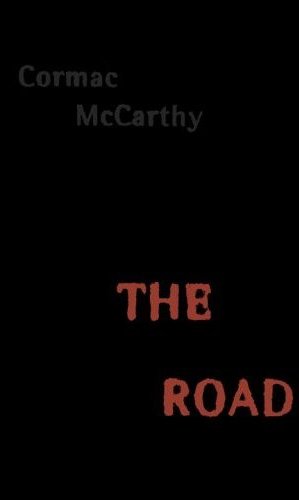
The Road, by Cormac Macarthy

After the sparse, stripped-down prose of No Country For Old Men, Macarthy is back with a chilling post-apocolyptic vision of the future. The following review is from Alan Warner, author of the Scottish existential angst-ridden Morvern Callar. The only thing missing is a mention of William Gay among his Tough Guys.


The road to hell

The Guardian Saturday,
November
4th, 2006

Shorn of history and context, Cormac McCarthy's other nine novels could be cast as rungs, with The Road as a pinnacle. This i
s a very great novel, but one that needs a context in both the past and in so-called post-9/11 America.

We can divide the contemporary American novel into two traditions, or two social classes. The Tough Guy tradition comes up from Fenimore Cooper, with a touch of Poe, through Melville, Faulkner and Hemingway. The Savant tradition comes from Hawthorne, especially through Henry James, Edith Wharton and Scott Fitzgerald. You could argue that the latter is liberal, east coast/New York, while the Tough Guys are gothi
c, reactionary, nihilistic, openly religious, southern or fundamentally rural.

The Savants' blood line (curiously unrepresentative of Americans generally) has gained undoubted ascendancy in the literary firmament of the US. Upper middle class, urban and cosmopolitan, they or their own species review themselves. The current Tough Guys are a murder of great, hopelessly masculine, undomesticated writers, whose critical reputations have been and still are today cruelly divergent, adrift and largely unrewarded compared to the contemporary Savant school. In literature as in American life, success must be total and
contrasted "failure" fatally dispiriting.

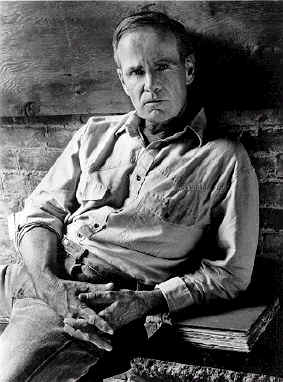
But in both content and technical riches, the Tough Guys are the true legislators of tortured American souls. They could include novelists Thomas McGuane, William Gaddis, Barry Hannah, Leon Rooke, Harry Crews, Jim Harrison, Mark Richard, James Welch and Denis Johnson. Cormac McCarthy is granddaddy to them all. New York critics may prefer their perfidy to be ignored, comforting themselves with the superlatives for All the Pretty Horses, but we should remember that the history of Cormac McCarthy and his achievement is not an American dream but near on 30 years of neglect for a writer who, since The Orchard Keeper in 1965, produced only masterworks in elegant succession. Now he has given us his great American nightmare.

The Road is a novel of transforming power and formal risk. Abandoning gruff but profound male camaraderie, McCarthy instead sounds the limits of imaginable love and despair between a diligent father and his timid young son, "each other's world entire". The initial experience of the novel is sobering and oppressive, its final effect is emotionally shattering.

America - and presumably the world - has suffered an apocalypse the nature of which is unclear and, faced with such loss, irrelevant. The centre of the world is sickened. Earthquakes shunt, fire storms smear a "cauterised terrain", the ash-filled air requires slipshod veils to cover the mouth. Nature revolts. The ruined world is long plundered, with canned food and good shoes the ultimate aspiration. Almost all have plunged into complete Conradian savagery: murdering convoys of road agents, marauders and "bloodcults" plunder these wastes. Most have resorted to cannibalism.
One passing brigade is fearfully glimpsed: "Bearded, their breath smoking through their masks. The phalanx following carried spears or lances ... and lastly a supplementary consort of catamites illclothed against the cold and fitted in dogcollars and yoked each to each." Despite this soul desert, the end of God and ethics, the father still defines and endangers himself by trying to instil moral values in his son, by refusing to abandon all belief.

All of this is utterly convincing and physically chilling. The father is coughing blood, which forces him and his son, "in their rags like mendicant friars sent forth to find their keep", on to the treacherous road southward, towards a sea and - possibly - survivable, milder winters. They push their salvage in a shopping cart, wryly fitted with a motorcycle mirror to keep sentinel over that road behind. The father has a pistol, with two bullets only. He faces the nadir of human and parental existence; his wife, the boy's mother, has already committed suicide. If caught, the multifarious reavers will obviously rape his son, then slaughter and eat them both. He plans to shoot his son - though he questions his ability to do so - if they are caught. Occasionally, between nightmares, the father seeks refuge in dangerously needy and exquisite recollections of our lost world.

They move south through nuclear grey winter, "like the onset of some cold glaucoma dimming away the world", sleeping badly beneath filthy tarpaulin, setting hidden campfires, exploring ruined houses, scavenging shrivelled apples. We feel and pity their starving dereliction as, despite the profound challenge to the imaginative contemporary novelist, McCarthy completely achieves this physical and metaphysical hell for us. "The world shrinking down to a raw core of parsible entities. The names of things slowly following those things into oblivion. Colours. The names of birds. Things to eat. Finally the names of things one believed to be true."

Such a scenario allows McCarthy finally to foreground only the very basics of physical human survival and the intimate evocation of a destroyed landscape drawn with such precision and beauty. He makes us ache with nostalgia for restored normality. The Road also encapsulates the usual cold violence, the biblical tincture of male masochism, of wounds and rites of passage. His central character can adopt a universal belligerence and misanthropy. In this damnation, rightly so, everyone, finally, is the enemy. He tells his son: "My job is to take care of you. I was appointed by God to do that ... We are the good guys." The other uncomfortable, tellingly national moment comes when the father salvages perhaps the last can of Coke in the world. This is truly an American apocalypse.

The vulnerable cultural references for this daring scenario obviously come from science fiction. But what propels The Road far beyond its progenitors are the diverted poetic heights of McCarthy's late-English prose; the simple declamation and plainsong of his rendered dialect, as perfect as early Hemingway; and the adamantine surety and utter aptness of every chiselled description. As has been said before, McCarthy is worthy of his biblical themes, and with some deeply nuanced paragraphs retriggering verbs and nouns that are surprising and delightful to the ear, Shakespeare is evoked. The way McCarthy sails close to the prose of late Beckett is also remarkable; the novel proceeds in Beckett-like, varied paragraphs. They are unlikely relatives, these two artists in old age, cornered by bleak experience and the rich limits of an English pulverised down through despair to a pleasingly wry perfection. "He rose and stood tottering in that cold autistic dark with his arms out-held for balance while the vestibular calculations in his skull cranked out their reckonings. An old chronicle."

Set piece after set piece, you will read on, absolutely convinced, thrilled, mesmerised with disgust and the fascinating novelty of it all: breathtakingly lucky escapes; a complete train, abandoned and alone on an embankment; a sudden liberating, joyous discovery or a cellar of incarcerated amputees being slowly eaten. And everywhere the mummified dead, "shrivelled and drawn like latterday bogfolk, their faces of boiled sheeting, the yellowed palings of their teeth".

All the modern novel can do is done here. After the great historical fictions of the American west, Blood Meridian and The Border Trilogy, The Road is no artistic pinnacle for McCarthy but instead a masterly reclamation of those midnight-black, gothic worlds of Outer Dark (1968) and the similarly terrifying but beautiful Child of God (1973). How will this vital novel be positioned in today's America by Savants, Tough Guys or worse? Could its nightmare vistas reinforce those in the US who are determined to manipulate its people into believing that terror came into being only in 2001? This text, in its fragility, exists uneasily within such ill times. It's perverse that the scorched earth which The Road depicts often brings to mind those real apocalypses of southern Iraq beneath black oil smoke, or New Orleans - vistas not unconnected with the contemporary American regime.

One night, when the father thinks that he and his son will starve to death, he weeps, not about the obvious but about beauty and goodness, "things he'd no longer any way to think about". Camus wrote that the world is ugly and cruel, but it is only by adding to that ugliness and cruelty that we sin most gravely. The Road affirms belief in the tender pricelessness of the here and now. In creating an exquisite nightmare, it does not add to the cruelty and ugliness of our times; it warns us now how much we have to lose. It makes the novels of the contemporary Savants seem infantile and horribly over-rated. Beauty and goodness are here aplenty and we should think about them. While we can.

· Alan Warner's latest novel is The Worms Can Carry Me to Heaven (Cape)


Thursday, November 09, 2006

Action woman


The Scotsman - February 9th 2002

From Elizabeth Balneaves’s kitchen window you can see a bird-table all a-flurry with shrill visitors. It’s a cheering sight but somewhat more domesticated than the view she had of the North Rhodesian bush, 40-odd years ago: "The smell of elephant lay heavy in the blazing heat of the afternoon ... a couple of black storks careened down through the treetops to land uncertainly like helicopters on the soft sand … A cloud of Zambesi lovebirds flashed emerald green almost across our faces and a lone baboon roared like a lion from the depths of the thicket."

It’s a far cry from the weekday afternoon lassitude of Cullen, the quiet Banffshire resort where Balneaves now lives; not quite so distant in memory, however, as this disconcertingly vigorous 90-year-old is busy writing her memoirs on the computer her sons gave her for her birthday last September. Balneaves’s main document sorting area is the kitchen table. It is littered with diaries, scrapbooks and photographs - depicting her stooped over a camp fire in the Hindu Kush, or wading in an African river hanging on to what she calls "the nonoperative end" of a sizeable python.

She is surveying her eventful life just as a biography has appeared of another Scots traveller, author and film-maker Isobel Wylie Hutchison. Balneaves herself was friendly with a third adventurer and chronicler, the Shetland-based Jenny Gilbertson, who, like Hutchison, filmed the indigenous peoples of the Arctic circle. All three ventured, often alone, into what was very much men’s territory.

Artist, author, film-maker, Balneaves has led what most of us, save perhaps the terminally adventurous, might describe as a full life. The daughter of an Aberdeen headmaster, she graduated from the city’s Gray’s School of Art in 1934, already engaged to psychologist Dr James Johnston: "We met at Wormwood Scrubs. He was on the staff and my uncle was a visiting doctor there."

At the end of the 1940s, they were living in Edinburgh and she was combining painting with looking after their four children until, as she puts it with a disarming insouciance, she "took off" for Pakistan, and not with her husband. "It’s … um … I’m writing my memoirs just now and it’s rather difficult, but I met this chap and went off with him and by the time I’d decided it wasn’t on, it was too late."

If the emotional attraction proved misguided, the relationship with Pakistan would be a lasting one, and formative - in order to live, she nursed, became temporary head of arts and crafts at the University of the Punjab in Lahore, wrote for Punjab Gazette and helped found and edit the Pakistan Review.

Returning to London, she launched into freelance journalism and promptly landed a commission for a book on Pakistan which sent her back there, taking her own photographs after the arranged snapper fell through. The result, The Waterless Moon, sported a foreword by Sir William Barton, former political agent in Swat and Chitral, describing it as "an extraordinary book, written by an extraordinary young woman of courage and grit … and with all this that rare gift of close observation and the faculty of describing what she sees in vivid language."

Plaudits apart, the book hardly made her fortune and, by this time in her late forties, she started taking photographs for companies involved in hydro-electric power and other schemes in Pakistan. One such job involved clambering up the outside ladder of a water tower. "I managed to get to the top and the German engineer I was with said , ‘Ach, you vomen of today!’ If he’d only known that the woman of today was shaking like a jelly. But I got the photograph."

Another book, Peacocks and Pipeless, resulted. Around that time, largely at the behest of their children, she re-married the long-suffering Johnston who was posted to Carstairs State Hospital. "I had a marvellous time. I taught eight murderers to paint," she says with some glee.

When one of her sons, Stewart, got a job in tobacco farming in what was then Northern Rhodesia, she seized the opportunity and ended up documenting the rescue of animals as, during the late 1950s, the Kariba dam project was flooding a vast area, displacing both people and animals. Her Elephant Valley was about game and tsetse supervisor Joe MacGregor Brooks, who was carrying out a private animal rescue operation of his own.

She returned with her first film camera and also a commission from Edinburgh Zoo, for whom she’d been working as a PR, to bring back some animals. She made a short film for schools television on the capture of an aardvaark: "I edited it in the attic, wrote the commentary and read it. They wanted ten minutes and I think it was just a minute out," she recalls.

Further films followed, articles in The Scotsman and National Geographic, among other journals; there was a return to Pakistan and the Hindu Kush, and another book, Mountains of the Murgha Zerin.

Many of her forays were made virtually alone, or in very much men-only environments. Did she ever feel at risk? "No. I feel more at risk here when someone bashes on my door at half-past 12 at night. The only time I did feel at risk was in Calcutta, where I was burgled one night."

She and her husband moved to Shetland, which prompted another book, The Windswept Isles, and where, through their respective daughters, she got to know the Glasgow-born documentary film-maker Jenny Gilbertson.

Gilbertson had become hooked after seeing amateur holiday film of Loch Lomond and, self-taught, had gone on to make a string of film documentaries about Shetland life at a time when, thanks to the likes of Michael Powell and Robert Flaherty, films about remote communities were becoming popular. Gilbertson emerged from the Scottish hotbed of documentary film making, encouraged by the crusty pioneer John Grierson, who described her first effort, A Crofter’s Life in Shetland, in 1931 as "an extraordinary job of work.

Among Gilbertson’s other films were The Rugged Island, made in 1934 about the life of a Shetland crofter - whom she ultimately married - and a film about Shetland ponies which took her four years to make.

Gilbertson, recalls Janet McBain, curator of the Scottish Film Archive in Glasgow, may have been small in stature, "but she was ten feet tall in action and energy". Gilbertson died in 1990 and the archive now holds much of her material, while seats in both the Glasgow Film Theatre and Edinburgh Filmhouse are dedicate in her name by Shetland Islands Council.

"We had a lot of fun together," Balneaves recalls of Gilbertson. The pair travelled together to Papa Stour, filming the island’s famous sword dance, though the film itself seems to have vanished without trace.

Still feeling that outward urge in her 70s, Gilbertson headed for the Canadian Arctic to film the changing life of the Inuit, among other things documenting the 300-mile journey made by one dog team. Balneaves was supposed to join her on one such Canadian expedition, but caught pneumonia beforehand so Gilbertson, as she did so often, went alone.

Balneaves, for her part, made her last working trip in 1982, after her one-time book subject, Brooks MacGregor, asked for help in publicising elephant poaching in Zambia. "I did 15 miles through the bush, twice, with a game guard - got some super photos of buffalo." She was 71.

Jenny Gilbertson would almost certainly have known, or at least known of, the third and perhaps most remarkable in our triumvirate of doughty Scots women travellers, authors and (all self-taught) film-makers, Isobel Wylie Hutchison.

Brought up at Cardownie, a Scotsbaronial mansion outside Kirkliston, West Lothian, Hutchison grew from a reserved and private girl into a remarkable yet still little-known traveller, botanist, poet, author and film-maker, who between 1927 and 1936 made four major journeys to Greenland, the northern coasts of Alaska and Arctic Canada, at a time when it was rare for women to go any further north than the goldfields of Alaska and Yukon. She brought back botanical specimens, film footage and the makings of several books, including On Greenland’s Closed Shore, North to the Rime-Ringed Sun and Arctic Nights’ Entertainments. Her film footage, held by the Scottish Screen Archive, shows Greenlanders stepping out enthusiastically in Scottish dances taught to them by visiting whalers a century before.

Hutchison, who died in 1982, was an enigmatic combination of the wilfully determined and the near-mystical, seeing the hand of God in the sublime and awesome Arctic environment, and who did much of her travelling alone, or in the rough and ready, all-male company of sailors, trappers and hunters. As Gwyneth Hoyle of Trent University, Ontario, puts it in her newly published biography of Hutchison, Flowers in the Snow (University of Nebraska Press), "Leading a sheltered life in a Victorian home until she was nearly 30, Isobel expanded and blossomed in personality with each new adventure … She was like a flower whose bud remains tightly closed until the right circumstances cause it to open."

She was, as another commentator puts it, "gloriously out of step with the conventions of her time".

Was there something in the air, or the water, that should produce the likes of Hutchison and two other redoubtable Scots women traveller-film-makers within a couple of decades? David Munro, current director of the Royal Scottish Geographical Society, whose journal Hutchison edited for ten years, points out that within the Scottish tradition of producing notable explorers, several of them were women, such as Hutchison, or Ella Christie from Dollar, who travelled on foot from Istanbul into Central Asia and made a similar journey from Moscow.

"We seem to have a remarkably high proportion of women with boundless energy and insatiable curiosity, and that’s a very Scottish trait," says Munro. "In Hutchison’s writings she is always pulled on by what’s beyond the horizon. And she is undaunted by the discomforts, another Scottish trait. And you have these traits balanced against the fact that it was very unfashionable for women to be doing this sort of thing."

The Scottish education system, he reckons, was crucial, "but there was also the social system, with all sots of push-pull factors operating, from the Highland clearances to the claustrophobia of Edinburgh society."

Hutchison assiduously noted domestic details among the Icelanders, Greenlanders and Inuits she visited, what they cooked and how - not the kind of thing you’d find, as Hoyle remarks in her biography, "in the heroic narratives of male Greenland explorers".

Munro agrees that women travellers observe differently from their male counterparts: "With Hutchison you get to meet the people and you encounter the landscape, she notices everything, whereas with many another early travel writer it’s all about them … I can think of writers who don’t even tell you the names of the guys who are carrying the baggage for them."

According to Hoyle, Hutchison would never have called herself a feminist - "merely an independent person who may have observed the bonds of conventional society at home but was prepared to be as unconventional as necessary in her travels". Unconventional all three women’s lives may have been, but they were also long. Elizabeth Balneaves is still rattling away at her computer, a spry 90; Gilbertson was re-editing some of her films within two years of her death at the age of 88; Hutchison was 92 when she died, outliving all her family and most of her friends. Whatever the rigours of going it alone as a woman traveller, it doesn’t seem to require a government health warning.

Elizabeth 'Betty' Balneaves


My grandmother lived a full life until the day she died, November 7th. Just a few short weeks ago she celebrated her 95th birthday with a party at her home - matching the stragglers, my brother Sorley and cousin Tim, with whisky-drinking endurance into the wee hours of the morning. I have decided to return from New Zealand for her funeral in Scotland. Travelling round the world to celebrate her memory seems fitting. She was the most intrepid explorer I have ever known. My father, J Laughton Johnston, wrote the following obituary for The Scotsman (Tuesday 14th November 2006):


Elizabeth Balneaves (1911-2006)

Elizabeth, or Betty as she was known to friends and family, author, painter and filmmaker, was born in Aberdeen, the only child of Annie and Alexander Balneaves. She graduated from Aberdeen Art College and married the psychiatrist Dr James McL Johnston of Shetland extraction in 1934. Although they were separated for several years, Jim supported her in her work throughout their married life.

Betty wrote six books, made a number of documentary films, drew many portraits in pastel and charcoal and painted many landscapes, latterly mainly of Shetland and Cullen. In Shetland, which she first visited with Jim in 1934, she is perhaps best known for The Windswept Isles (1977), which she wrote during the 20 or so years she and Jim lived in retirement in the old manse at Bigton in the 1960s and '70s. This was her tribute to the people and the islands whom she always felt had adopted her.

During those years she also made a documentary film of Shetland for the BBC: People of Many Lands - Shetland. Although painting was her first love it was her writing that brought her to a wider public attention, one of the first signs of her literary talent being a poem published in 1945 in Poetry Scotland (2nd collection), that wonderful series of Scottish poetry books published by William MacLellan & Co.

In the early 1950s Betty travelled alone to Pakistan, particularly to Karachi and the Frontier with Afghanistan , where she stayed for several years, resulting in The Waterless Moon (1955) and Peacocks and Pipelines (1958), both of which received some critical acclaim. Later, she returned to the area with her son, Stewart, resulting in a third book on the area between the Hindu Khush and the Karakoram, The Mountains of the Murgha Zerin (1972) and some unique film footage of this remote area and its culture.

At a later date they returned to the Sunderbunds (in then East Pakistan), this time concentrating on documentary filmmaking. In 1959, between her second and third books, Betty visited the area being flooded (in then Southern Rhodesia) by the new Kariba Dam where Stewart was working. Here she made a documentary film of the effects of the flooding on wildlife - Logging in the Sundarabans, East Pakistan - and wrote the story of a colourful Scottish Game and Tsetse Supervisor called Joe McGregor Brooks entitled Elephant Valley (1962).

Just prior to this trip Betty worked as a publicity officer for the Edinburgh Zoo and as with everything she did, she made use of this experience in her only work of fiction, Murder in the Zoo (1974).

Betty had a great zest for life, travel, cooking, uisge-beatha and good company that continued into her old age, becoming computer literate on her 90th birthday and spending her next 5 years, right to the end, sending and receiving emails from her family and many grandchildren scattered across the globe. During this time she also began putting together the text for her final publication, her memoirs, which, alas, she never finished. Betty was an only child and it never ceased to astonish her that she had so many descendants. Betty died quietly in Elgin on the 7 th November, just eight weeks after celebrating her 95th birthday with most of her immediate family. She is survived by her four children, thirteen grandchildren and eleven great grandchildren.

Wednesday, October 18, 2006

Burning Man

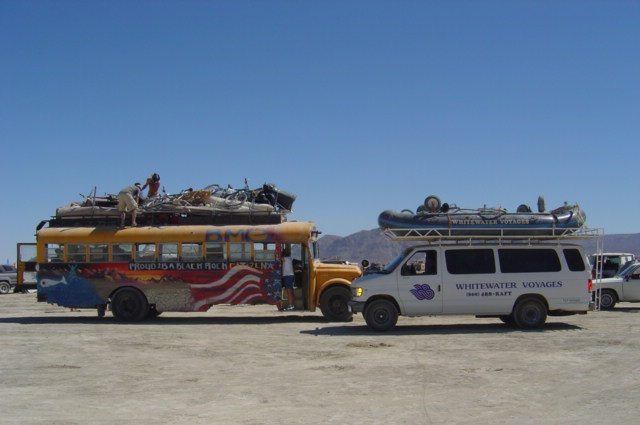
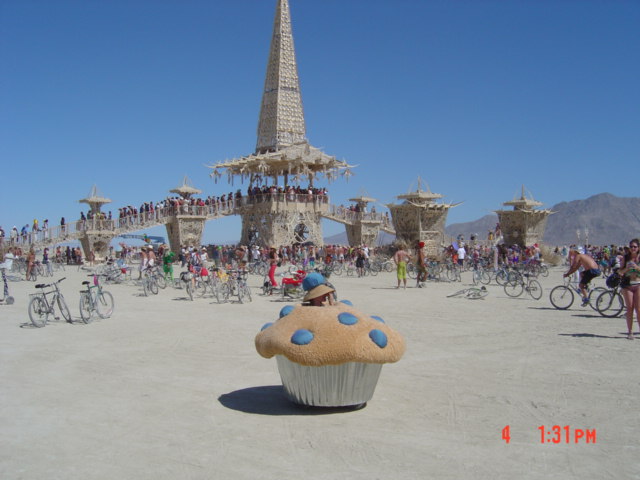
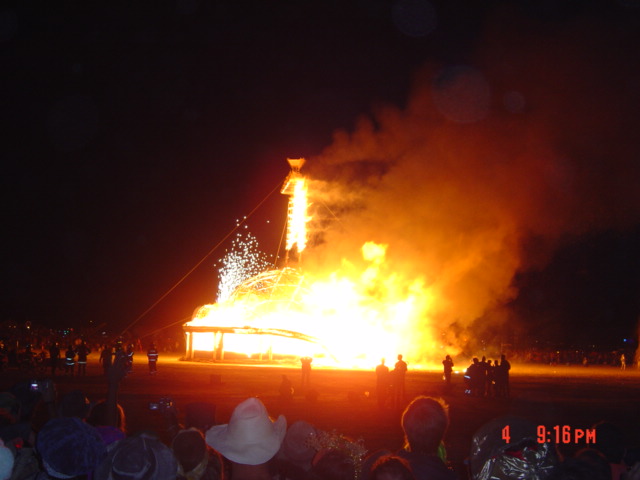
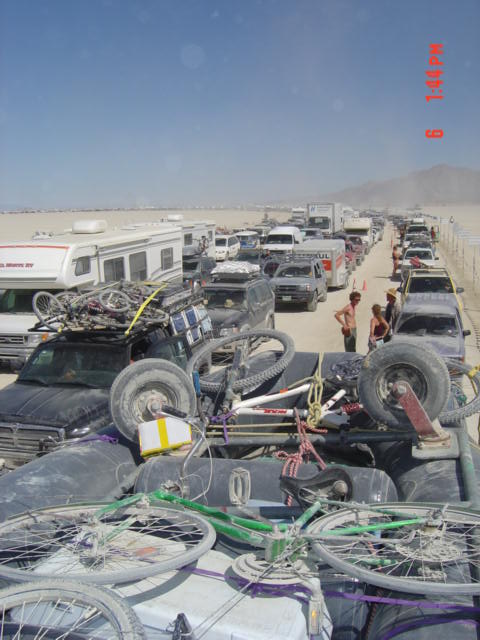
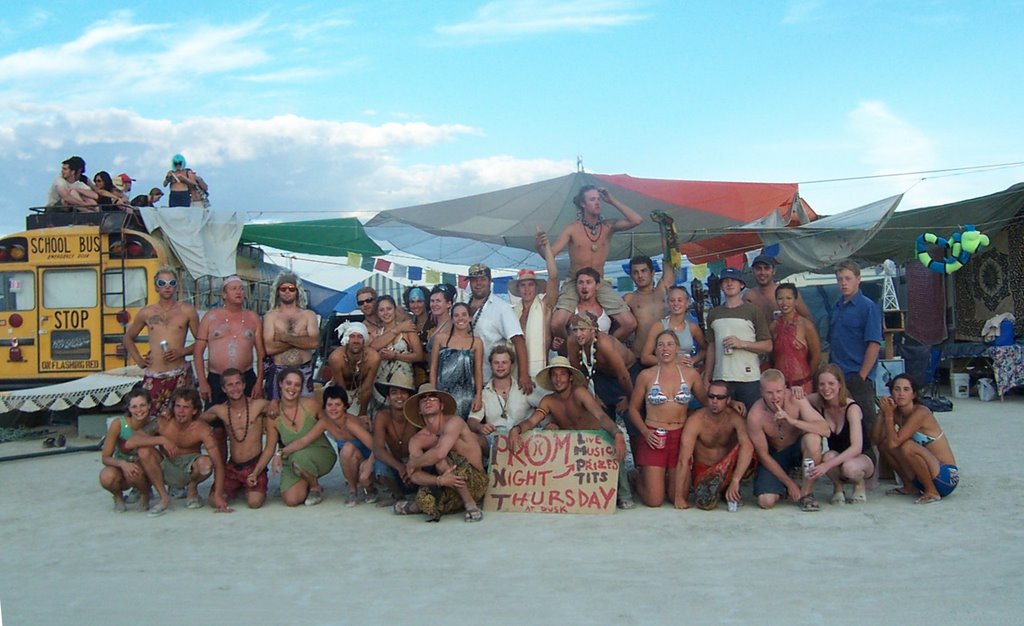
My friend, Brook Buswell, who took me under his wing for the two years I spent at Burning Man in the Nevada desert, recently sent me a reflection of his time at the free form arts festival that finished last month. It reminded me that I hadn't included the article I had published in The Herald Magazine on this blog. So here it is, in all its fiery glory. The pictures (except the last, which has me in the front row, 3rd from right) are all courtesy of my river-guide colleagues, Jasmine Jackson and Iain Morris, who managed to persuade the owner of our company, Whitewater Voyages, that taking a company van and raft would help sales of trips. Marvellous.


The Herald Magazine: Burn Baby Burn!
by Jamie M Johnston

My friend, wearing Stetson, flip-flops, shorts, goggles and with painted chest, turns to me and says, “Let’s get on the Dragon Bus.” “Where does it go?” I ask naively. “I have no idea,” was the suitably vague reply.

Five minutes later the driver of the Dragon Bus, an eighty foot construct of wheels and trailers fronted with a steam train and seats for one hundred crazies, looks back at me cross-eyed and screams, “Your not in Scotland now!”

We pull away from the dance tents, and streams of bikers, performance artists and scantily clad hippies, moving quickly into the desert. The wind whips dust into my army surplus goggles and I hold my hand tight over a cool Tanqueray and tonic. Spotting what looks like a tank I watch in fascination as it shoots flame high above the dust into the clear starry sky. Is this Madmax, or perhaps Fear and Loathing in Las Vegas?

Neither, it is Burning Man, the annual free-form arts festival founded by Larry Harvey that began as a beach party in San Francisco back in 1986 with the burning of a small wooden figure and has quickly become the event in America.

It springs up out of the desert floor and, in a bursting ball of flame, just as quickly turns to ash to merge with the clouds of dust that swirl and rage indiscriminately across this lunar landscape.

For one week only Black Rock City becomes the third biggest city in Nevada with figures of around 30,000 in attendance. It is situated some 120 miles northeast of the gambling, strip club, neon lighted Reno where most stock up on supplies for the week.

Enjoyment of the art, the people and the music can only be truly appreciated if one has arrived dutifully prepared with food, water and good accommodation. As my grandmother always said, “Recharging of the batteries is essential for a week long hedonistic festival.”


The best information to be found on the event is at www.burningman.com. The site comes fully loaded with essays, pictures, ideas and documentation of previous Burning Man festivals.

For outsiders who see Burning Man as a hippy fest of long hair, little amount of clothes, and pagan like dancing around huge bonfires, the incorporation of up to date technology in the art and in the running of the festival may come as a shock.

The ethos at work, according to the site, is that “Burning Man is an annual experiment in temporary community dedicated to radical self-expression and radical self-reliance.” This covers the main three areas at work in Burning Man.

The first, temporary community, means that one has to stay and immerse one’s self in the event. Here you can only be a participant. There are no spectators. Signalling this is the fact there are no day passes sold or discounts offered for partial duration.

To feel the true essence you have to become part of the community that is based on giving and sharing where you need and rely on others whom, in turn, need and rely upon you.

Larry Harvey’s comments on the shift in the media’s coverage of the event in an interview with Darryl Van Rhey from 1998 also highlight this idea of inclusion.

“…..they had to come, camp, live and survive among us. They had no choice but to immerse themselves in the story. This is radical inclusion – very Burning Man … as actual citizens of our city, they realized that our talk about community betokens something real.”

Secondly there is radical self-expression. Every year is themed and this year’s was the Vault of Heaven. But Black Rock City is a semicircle of smaller themed camps created by the citizens themselves.

They ranged from a car with tent that offered a chance to throw darts at pictures of the Royal Family (hugely popular) to a giant canopy with living quarters for twenty boasting a Full Contact Croquet League.

The atmosphere changes with your location. If you want madness go and fight your friend in the recreated Thunderdome, or chat amicably with strangers in centre camp, or dance like a madman at Disturbia, or simply stare at the sky peacefully in The Mausoleum with 360-degree alien desert noises.

No money is made from the festival. People are stripped of their creature comforts and normal social boundaries are left back in Reno. People wander freely completely naked, or paint themselves blue. Some come in their RVs. Some have a tent. But everyone becomes equal due to the saturation by the playa dust that gets in your food, in your bed and sooner or later, into every orifice.

Lastly there is “radical self-reliance”, or more aptly, survival. The only items one can buy are coffee and ice. Anything else you require must be bartered for from the other citizens. There is no legal tender or corporate sponsorships. If you want a drink, drugs, food or a hat then you must offer something in return.

To come unprepared is suicide. Sure you can swap a few things for some food and water. But who do you call on when it is 107 degrees and you have no shade, when the wind picks up to 70mph and your tarp whisks off into the sky, or when during the night the temperature plummets and your shorts and t-shirt are no longer adequate.

There is a reason for Burning Man being situated where it is. Here the elements are harsh and unforgiving. One has to look after one’s self and then look to the fellow man. There is no vending. The community shares and thrives.

To get around this vast 400 square mile dried up riverbed one should really bring a bike, moped, or trumped up lawn mower. My only brush with authority came when riding my moped. Unbeknown to me vehicles can only be used if they are licensed art vehicles. So after a facelift for my moped I went to the local DMV – the Department of Mutant Vehicles – to register my new vehicle.

To be honest this is the only kind of pressure to be found at Burning Man. The need to conform to nonconformity. You are not normal, or part of the crowd, unless abnormal. Funny then that Harvey, the founder, struts around with shades, trademark Stetson, shirt and jeans. He comments on his attire, “I’ve hated going along with the crowd all my life.”

As with any major contemporary festival drugs are rife and easy to get hold of. However, with so much man made visual stimuli on offer suffused with the natural dramatic backdrop of open desert and clear sky a natural high pervades the mood.

This is not a gathering dictated by the drugs on offer. This is Burning Man. Where a mist of mellowness, slow watchfulness and fascination sweeps over all. Life is brash, bright and loud, but equally slow and cautious. Burning Man is an altered reality that is literally burned to the ground after a week. Looking back it feels like you were hallucinating. But for me drugs had absolutely nothing to do with it.

Multitudes of workers and helpers arrive and leave sometimes months before and after the thousands of Black Rock citizens. Although the festival proper begins on a Monday and climaxes on the Saturday night with the burning of The Man, a forty-foot wooden construct atop an altar that towers above it all.

The climax approaches. Out in the playa the citizens gather around The Man. We are treated to a spectacular fire show with various Mad Max-like vehicles shooting balls of multicoloured flame at The Man and leather-clad fire-dancers spinning poi to a hypnotic drum beat.

With a full moon competing for attention the crowd chants “Run Burning Man Run”, until the whole neon effigy becomes a giant bonfire. As The Man collapses to the ground, the crowd rushes in screaming to dance madly around the white-hot embers, throwing in material possessions and things of sentimental value.

For the rest of the evening the citizens waltz from one fire-show to the next. The art projects dotted around the playa, carefully laboured on for the best part of a year, are quickly burned to the ground. When I saw a hundred foot matchstick-made cathedral go up, it burned so white it felt like my eyeballs would melt.

Fresh ideas and new beginnings are the name of the game.

This year’s theme asked a few questions: Where does everything come from? Where does everything go? And where and how, in this vast scheme of things, do we fit in? While sitting in a field of flapping flags with nothing else in sight I plucked up the courage for one brief moment – I’m British – to strip off and sit and contemplate my existence like Hugh MacDiarmid on his raised beach, or more aptly, Rilke in the Arabian desert.

Although Black Rock City disappears physically every year, people never leave quite the same. Everyone is talking a little piece of Burning Man back to his or her prospective realities. The Burning Man website acts as a gateway into the ever growing matrix of sites created by participants over the years who wish to prolong the reality at work in Black Rock City.

Along with this we now have Danger Ranger’s journey through America that is being documented on the website. This “Mystic Shaman Cowboy” has a mission to cut short the anxiety felt by the citizens of Black Rock after the Burning Man event when they realise that they have another 358 days to wait until the community is reunited once again.

“Danger’s message to you is that you need no longer wait. Take what you have learned from your experience, organize with friends and fellow burners, and be ready to greet him.”

The temporary community is slowly finding ways to elongate itself and prolong the reality at work in Burning Man. The message is clear, “Burning Man is not an event, but a new way of doing and being wherever you are. It is a movement, a force, a river: a culture with a thousand tributary streams.” This festival in the desert acts as a reminder. That life is only what you make it. With the global terrorism crisis our generation seems set to endure over the coming years, who says that the Burning Man mantra does not have a place in our world?

William Gay

The one author - aside from my brother-in-law David Anthony Durham - who's progress I monitor most eagerly, is William Gay. His writing crackles with vivid description and lucid melancholia capable of making a tee-totaller reach for the bottle. His is a world of the American south.
Gothic, humorous, elemental and dark.


As a writer I often feel like a fake, a phony, regurgitating the thoughts and words of others. Gay is someone who seems true to his work. How far does his imagination stretch? Are these stories he's picked up from saloon conversations, long-dead uncles or grandparents? Durham once read with him on a book-tour for Doubleday and he described a man just as I'd imagined after reading his books.

He has a new novel coming out soon, Twilight, about a young man who uncovers the murky truth behind a local undertaker. Chased through the witch-ridden woods by a local hired killer, Gay rewrites the gothic fairytale for the modern American South.

The following blurbs came from Amazon:

Gay (
The Long Home) fills the book with haunting imagery and shocking, morbid and (surprisingly) hopeful turns as twisted justice gets meted out. Language lovers who are not faint of heart won't want to miss this one.
(Oct. 20)
Copyright © Reed Business Information, a division of Reed Elsevier Inc. All rights reserved.

Though Gay has sometimes been compared with Faulkner, it's Davis Grubb and his wonderful novel The Night of the Hunter that provides much of the inspiration here (a quote from Grubb opens the novel's second section). Though veering sometimes dangerously close to melodrama, Gay seems incapable of writing a dull sentence, and Twilight is further redeemed by his brilliant gift for dialogue, his occasional dark humor, and his utterly convincing portrayal of the reality of ruination and of evil.
Michael Cart
Copyright © American Library Association. All rights reserved