Wednesday, October 18, 2006

Burning Man

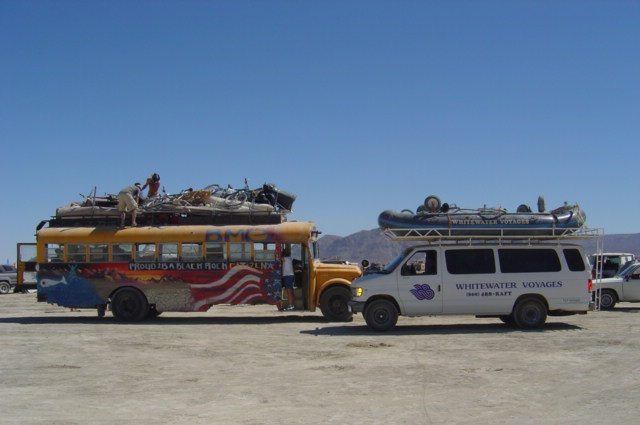
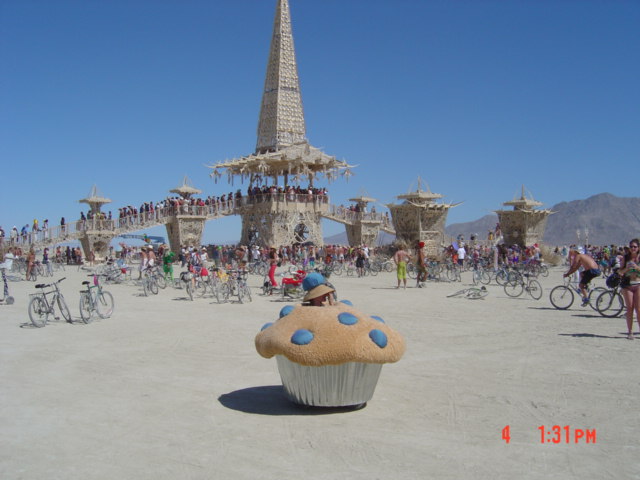
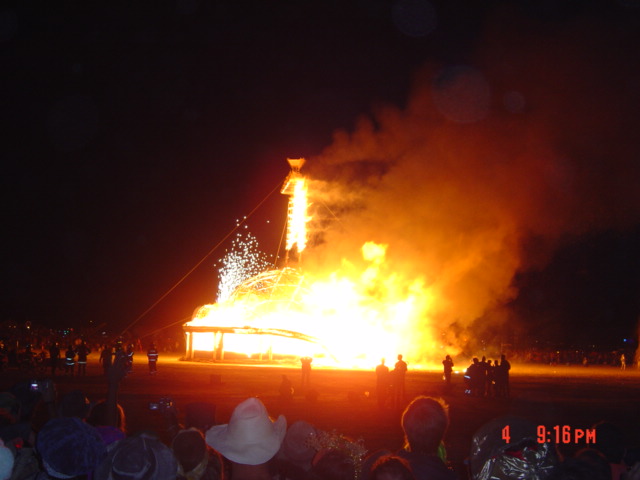
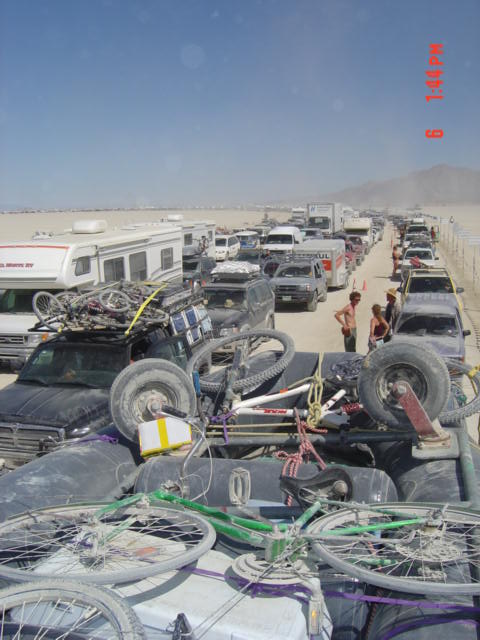
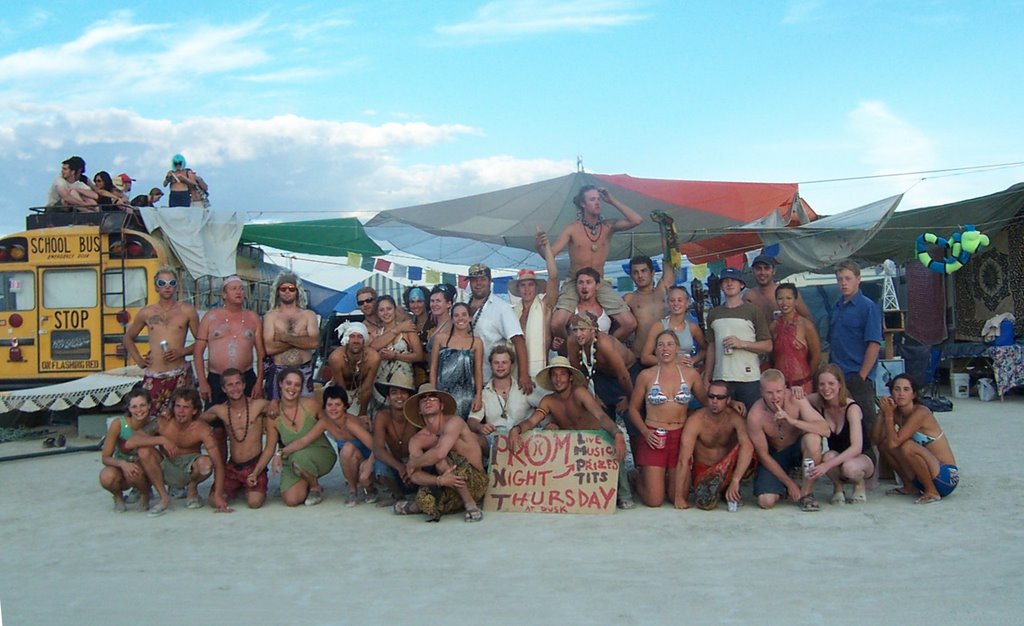
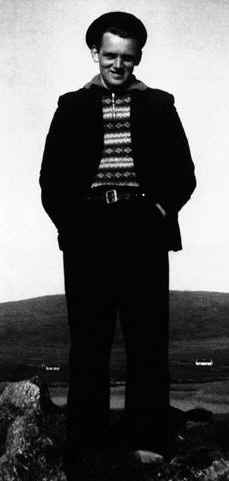
My friend, Brook Buswell, who took me under his wing for the two years I spent at Burning Man in the Nevada desert, recently sent me a reflection of his time at the free form arts festival that finished last month. It reminded me that I hadn't included the article I had published in The Herald Magazine on this blog. So here it is, in all its fiery glory. The pictures (except the last, which has me in the front row, 3rd from right) are all courtesy of my river-guide colleagues, Jasmine Jackson and Iain Morris, who managed to persuade the owner of our company, Whitewater Voyages, that taking a company van and raft would help sales of trips. Marvellous.



The Herald Magazine: Burn Baby Burn!
by Jamie M Johnston

My friend, wearing Stetson, flip-flops, shorts, goggles and with painted chest, turns to me and says, “Let’s get on the Dragon Bus.” “Where does it go?” I ask naively. “I have no idea,” was the suitably vague reply.

Five minutes later the driver of the Dragon Bus, an eighty foot construct of wheels and trailers fronted with a steam train and seats for one hundred crazies, looks back at me cross-eyed and screams, “Your not in Scotland now!”

We pull away from the dance tents, and streams of bikers, performance artists and scantily clad hippies, moving quickly into the desert. The wind whips dust into my army surplus goggles and I hold my hand tight over a cool Tanqueray and tonic. Spotting what looks like a tank I watch in fascination as it shoots flame high above the dust into the clear starry sky. Is this Madmax, or perhaps Fear and Loathing in Las Vegas?

Neither, it is Burning Man, the annual free-form arts festival founded by Larry Harvey that began as a beach party in San Francisco back in 1986 with the burning of a small wooden figure and has quickly become the event in America.

It springs up out of the desert floor and, in a bursting ball of flame, just as quickly turns to ash to merge with the clouds of dust that swirl and rage indiscriminately across this lunar landscape.

For one week only Black Rock City becomes the third biggest city in Nevada with figures of around 30,000 in attendance. It is situated some 120 miles northeast of the gambling, strip club, neon lighted Reno where most stock up on supplies for the week.

Enjoyment of the art, the people and the music can only be truly appreciated if one has arrived dutifully prepared with food, water and good accommodation. As my grandmother always said, “Recharging of the batteries is essential for a week long hedonistic festival.”


The best information to be found on the event is at www.burningman.com. The site comes fully loaded with essays, pictures, ideas and documentation of previous Burning Man festivals.

For outsiders who see Burning Man as a hippy fest of long hair, little amount of clothes, and pagan like dancing around huge bonfires, the incorporation of up to date technology in the art and in the running of the festival may come as a shock.

The ethos at work, according to the site, is that “Burning Man is an annual experiment in temporary community dedicated to radical self-expression and radical self-reliance.” This covers the main three areas at work in Burning Man.

The first, temporary community, means that one has to stay and immerse one’s self in the event. Here you can only be a participant. There are no spectators. Signalling this is the fact there are no day passes sold or discounts offered for partial duration.

To feel the true essence you have to become part of the community that is based on giving and sharing where you need and rely on others whom, in turn, need and rely upon you.

Larry Harvey’s comments on the shift in the media’s coverage of the event in an interview with Darryl Van Rhey from 1998 also highlight this idea of inclusion.

“…..they had to come, camp, live and survive among us. They had no choice but to immerse themselves in the story. This is radical inclusion – very Burning Man … as actual citizens of our city, they realized that our talk about community betokens something real.”

Secondly there is radical self-expression. Every year is themed and this year’s was the Vault of Heaven. But Black Rock City is a semicircle of smaller themed camps created by the citizens themselves.

They ranged from a car with tent that offered a chance to throw darts at pictures of the Royal Family (hugely popular) to a giant canopy with living quarters for twenty boasting a Full Contact Croquet League.

The atmosphere changes with your location. If you want madness go and fight your friend in the recreated Thunderdome, or chat amicably with strangers in centre camp, or dance like a madman at Disturbia, or simply stare at the sky peacefully in The Mausoleum with 360-degree alien desert noises.

No money is made from the festival. People are stripped of their creature comforts and normal social boundaries are left back in Reno. People wander freely completely naked, or paint themselves blue. Some come in their RVs. Some have a tent. But everyone becomes equal due to the saturation by the playa dust that gets in your food, in your bed and sooner or later, into every orifice.

Lastly there is “radical self-reliance”, or more aptly, survival. The only items one can buy are coffee and ice. Anything else you require must be bartered for from the other citizens. There is no legal tender or corporate sponsorships. If you want a drink, drugs, food or a hat then you must offer something in return.

To come unprepared is suicide. Sure you can swap a few things for some food and water. But who do you call on when it is 107 degrees and you have no shade, when the wind picks up to 70mph and your tarp whisks off into the sky, or when during the night the temperature plummets and your shorts and t-shirt are no longer adequate.

There is a reason for Burning Man being situated where it is. Here the elements are harsh and unforgiving. One has to look after one’s self and then look to the fellow man. There is no vending. The community shares and thrives.

To get around this vast 400 square mile dried up riverbed one should really bring a bike, moped, or trumped up lawn mower. My only brush with authority came when riding my moped. Unbeknown to me vehicles can only be used if they are licensed art vehicles. So after a facelift for my moped I went to the local DMV – the Department of Mutant Vehicles – to register my new vehicle.

To be honest this is the only kind of pressure to be found at Burning Man. The need to conform to nonconformity. You are not normal, or part of the crowd, unless abnormal. Funny then that Harvey, the founder, struts around with shades, trademark Stetson, shirt and jeans. He comments on his attire, “I’ve hated going along with the crowd all my life.”

As with any major contemporary festival drugs are rife and easy to get hold of. However, with so much man made visual stimuli on offer suffused with the natural dramatic backdrop of open desert and clear sky a natural high pervades the mood.

This is not a gathering dictated by the drugs on offer. This is Burning Man. Where a mist of mellowness, slow watchfulness and fascination sweeps over all. Life is brash, bright and loud, but equally slow and cautious. Burning Man is an altered reality that is literally burned to the ground after a week. Looking back it feels like you were hallucinating. But for me drugs had absolutely nothing to do with it.

Multitudes of workers and helpers arrive and leave sometimes months before and after the thousands of Black Rock citizens. Although the festival proper begins on a Monday and climaxes on the Saturday night with the burning of The Man, a forty-foot wooden construct atop an altar that towers above it all.

The climax approaches. Out in the playa the citizens gather around The Man. We are treated to a spectacular fire show with various Mad Max-like vehicles shooting balls of multicoloured flame at The Man and leather-clad fire-dancers spinning poi to a hypnotic drum beat.

With a full moon competing for attention the crowd chants “Run Burning Man Run”, until the whole neon effigy becomes a giant bonfire. As The Man collapses to the ground, the crowd rushes in screaming to dance madly around the white-hot embers, throwing in material possessions and things of sentimental value.

For the rest of the evening the citizens waltz from one fire-show to the next. The art projects dotted around the playa, carefully laboured on for the best part of a year, are quickly burned to the ground. When I saw a hundred foot matchstick-made cathedral go up, it burned so white it felt like my eyeballs would melt.

Fresh ideas and new beginnings are the name of the game.

This year’s theme asked a few questions: Where does everything come from? Where does everything go? And where and how, in this vast scheme of things, do we fit in? While sitting in a field of flapping flags with nothing else in sight I plucked up the courage for one brief moment – I’m British – to strip off and sit and contemplate my existence like Hugh MacDiarmid on his raised beach, or more aptly, Rilke in the Arabian desert.

Although Black Rock City disappears physically every year, people never leave quite the same. Everyone is talking a little piece of Burning Man back to his or her prospective realities. The Burning Man website acts as a gateway into the ever growing matrix of sites created by participants over the years who wish to prolong the reality at work in Black Rock City.

Along with this we now have Danger Ranger’s journey through America that is being documented on the website. This “Mystic Shaman Cowboy” has a mission to cut short the anxiety felt by the citizens of Black Rock after the Burning Man event when they realise that they have another 358 days to wait until the community is reunited once again.

“Danger’s message to you is that you need no longer wait. Take what you have learned from your experience, organize with friends and fellow burners, and be ready to greet him.”

The temporary community is slowly finding ways to elongate itself and prolong the reality at work in Burning Man. The message is clear, “Burning Man is not an event, but a new way of doing and being wherever you are. It is a movement, a force, a river: a culture with a thousand tributary streams.” This festival in the desert acts as a reminder. That life is only what you make it. With the global terrorism crisis our generation seems set to endure over the coming years, who says that the Burning Man mantra does not have a place in our world?

William Gay

The one author - aside from my brother-in-law David Anthony Durham - who's progress I monitor most eagerly, is William Gay. His writing crackles with vivid description and lucid melancholia capable of making a tee-totaller reach for the bottle. His is a world of the American south.
Gothic, humorous, elemental and dark.


As a writer I often feel like a fake, a phony, regurgitating the thoughts and words of others. Gay is someone who seems true to his work. How far does his imagination stretch? Are these stories he's picked up from saloon conversations, long-dead uncles or grandparents? Durham once read with him on a book-tour for Doubleday and he described a man just as I'd imagined after reading his books.

He has a new novel coming out soon, Twilight, about a young man who uncovers the murky truth behind a local undertaker. Chased through the witch-ridden woods by a local hired killer, Gay rewrites the gothic fairytale for the modern American South.

The following blurbs came from Amazon:

Gay (
The Long Home) fills the book with haunting imagery and shocking, morbid and (surprisingly) hopeful turns as twisted justice gets meted out. Language lovers who are not faint of heart won't want to miss this one.
(Oct. 20)
Copyright © Reed Business Information, a division of Reed Elsevier Inc. All rights reserved.

Though Gay has sometimes been compared with Faulkner, it's Davis Grubb and his wonderful novel The Night of the Hunter that provides much of the inspiration here (a quote from Grubb opens the novel's second section). Though veering sometimes dangerously close to melodrama, Gay seems incapable of writing a dull sentence, and Twilight is further redeemed by his brilliant gift for dialogue, his occasional dark humor, and his utterly convincing portrayal of the reality of ruination and of evil.
Michael Cart
Copyright © American Library Association. All rights reserved

Sunday, September 17, 2006

Elizabeth Magill


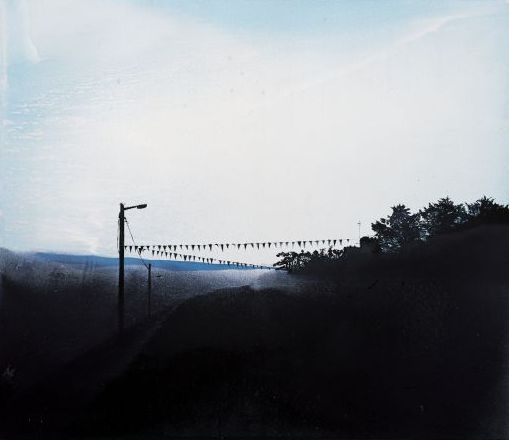
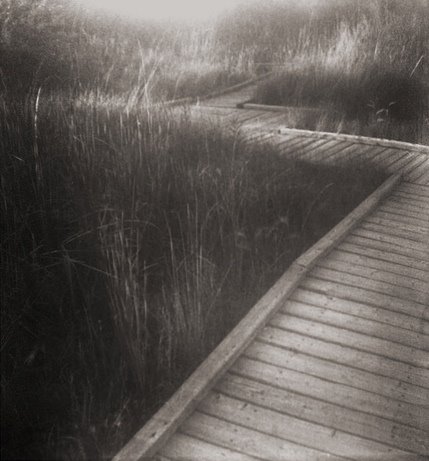
For some reason it took me years before my first visit to Newcastle, and this despite living with a larger-than-life Geordie for my undergraduate years in Glasgow. We finally made it there in October 2004 and visited the Baltic, Centre for Contemporary Arts. I fell in love with the work of Northern Irish artist Elizabeth Magill who had an exhibition on. My wife, Helen, gave me a book of her paintings and one day I will get my favourite lonely cabin shots from it up on this blog. For now, the above will have to suffice.

T Gray

Face Off:

Construction Destruction:

Wyoming Schoolhouse:

Robidoux Trading Post:


Going Nowhere:

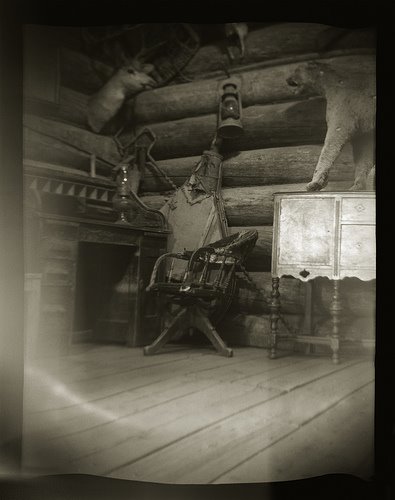
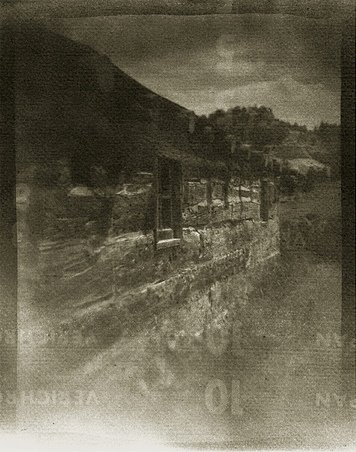
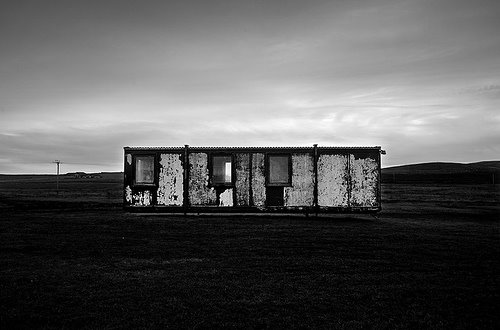
Although not all of cabins, these pictures are certainly lonely. I found them on www.flickr.com just doing a routine search. There are some amazing pictures out there just waiting and wanting to be displayed. Hope T Gray doesn't mind.

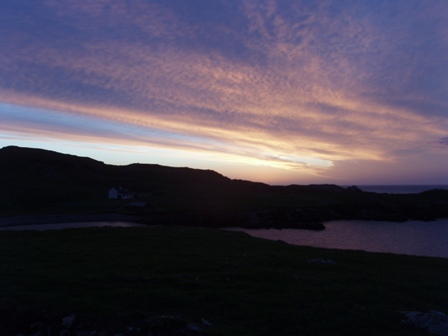
Muckle Bousta, Sandness, Shetland


I should have really begun my loneliest cabin series with Muckle Bousta, my parents' croft on the Shetland Islands. I'll need to pester my brother to see if he has some black and white or sepia shots of the place.

John Carolan


It has been my intention to collect pictures, paintings and photographs of the loneliest cabin. This series are all from the lens of John Carolan, and are all, I think, in Shetland.

Helen and I bought a photo of his for my sister Beth's wedding to Nick.

Friday, September 15, 2006

Thomas Fraser

While visiting my friend Paul in Hong Kong (en route to New Zealand from Thailand) last month he showed me an article he'd kept a hold of, knowing my Shetland roots, and love of music. Here's the opening to it:


How a Shetland fisherman found fame in Nashville almost 30 years after his tragic death. From the Isle of Burra, Peter Culshaw reports

Sunday June 18, 2006
Observer Music Monthly


The Tale of Thomas Fraser


"It feels as if this might be the start of an initiation into a cult - one which is growing by the day. We have found the room in the croft in Outterabrake, in the Shetland Islands, where Thomas Fraser made his first recordings. We have the key fetish objects - the Grundig tape machine he recorded himself on, and the Levin Goliath guitar he played - which we are photographing, imagining Fraser himself playing away, the peat fire burning, on one of those endless winter Shetlands nights where it gets dark by 3pm. Fraser died, aged 50, in 1978 - but only now is he reaching an audience."

Back to me. I visited his website and you can listen to a sample of the songs. They're brilliant. Plenty of country yodelling, a strong voice, and solid accompaniment on the guitar.

His blues and laments have added weight when you know Shetland, and can imagine him playing in his croft with the wind trying to rip the roof off.

My faither's novel

Delighted to announce my father, Laughton, has his first fiction novel published this year. It's a tale about growing old but not forgetting your youth. I read somewhere that the older you get the more you regress back to your youth. Grandparents are always great with young kids aren't they?

The picture below is my dad and his grandson, my nephew, Ben.

A Dream of Silver, by J. Laughton Johnston


Shetland Times
July 2006

Due to the decline in his health, an old man is forced to move from his retirement cottage on Shetland to live at the Edinburgh home of his 10-year-old grandson. As a way of making contact with a child he hardly knows, and who hardly knows him, the old man begins to tell the boy the story of his own childhood and of his encounter with the works of the two giants of Scottish literature of the 18th and 19th century.

It is a moral and physical journey; the narratives of the grandfather and grandson, and that of the old man’s childhood, closely interweaving.
The pair seek out the old man’s first home by the sea front at Newhaven where the nightly beam from a lighthouse, flickering on the wall above his bed, became the one dependable fixture in his otherwise unstable world and where escape from painful reality induced an imaginary relationship with the ambiguous hero of his favourite storybook.

From the old fishing village they trace the path of the old man’s childhood misadventure along the shores of the Forth to Queensferry and then over the sea to Shetland.
In Shetland, the narratives come to a climax at a lighthouse perched on the most southerly point of the islands, where the historical paths of the two Scottish novelists cross, and where grandson, grandfather and the child that is now an old man, all face and comprehend uncomfortable and unavoidable truths.

Laughton Johnston is better known for his writings on natural history and nature conservation. He has written and co-written four books in this field, including two accounts of the wildlife of Shetland. Prior to, and in the early days of working in the natural environment, from where he gained the material for these publications, however, he also published poetry in several Scottish poetry magazines and anthologies resulting, in 1980, in a Scottish Arts Council award. Writing fiction has always been a long-term ambition and A Dream of Silver is his first novel.

Although he was brought up in Edinburgh, Johnston has spent a number of years in Shetland from where his father’s family originated and where he and his wife are now resident. He is presently finalizing a biography of a notable Shetland landowning family, gleaned from their many scientific, political and literary publications and private letters; it is to be published by The Shetland Times in the near future.

Published by the Shetland Times Ltd., Gremista, Lerwick, Shetland ZE1 0PX
Tel 01595 693622 Fax: 01595 694637
email: publishing@shetland-times.co.uk
www.shetland-books.co.uk
Sale representation by Seol Ltd.,
West Newington House, 10 Newington Road, Edinburgh EH9 1QS

Tel: 0131 668 1456 Fax: 0131 668 3777
Distributors for Scottish Mainland and Western Isles are Book Source, 32 Finlas Street, Glasgow
Rest of UK and world-wide by The Shetland Times Bookshop, 71-79 Commercial Street, Lerwick, Shetland, ZE1 0AJ
Tel: 01595 695531 Fax: 01595 692897
email: bookshop@shetland-times.co.uk
For further information please contact Charlotte Black, Publications Manager. email: c.black@shetland-times.co.uk

The Voluntourists, by Jamie M Johnston


Issue 14: Eco Adventures

Jul / Aug 2006
Lifestyle and Travel Magazine

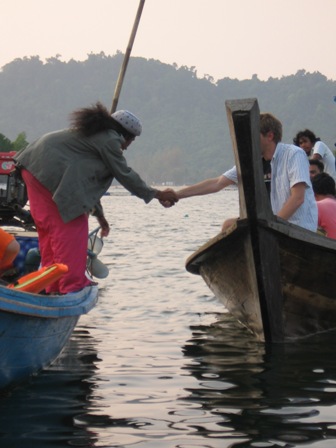
Pictures courtesy of North Andaman Tsunami Relief

Before Jamie M. Johnston set off for Thailand, he and his wife researched possible destinations
using internet search keywords like ‘responsible travel’, ‘eco-friendly’ and ‘sustainable tourism’.

They knew that ecotourism has a lot of potential for developing countries that boast a broad range of unique and pristine natural features. They found a lot more than they bargained for.

Some of the first areas to develop ecotourism – such as Kenya, the Galapagos Islands and Thailand – have already greatly suffered from weak development controls and ever increasing numbers of tourists. My wife and I arrived in Bangkok pragmatic, yet hopeful for some real cultural and adventurous experiences.

After a spell up north, and a disappointing introduction to the south, we made our way to Khao Sok National Park, which in turn led us to the small town of Kuraburi – a popular rest stop for those heading to the Marine National Park of Koh Surin. From there we visited Golden Buddha Beach, an eco-resort with a resident Sea Turtle Conservation project on the stunning small island of Koh Phra Thong. We strolled hand in hand, along kilometre after kilometre of untouched, pristine, golden beach with a fiery red and orange sunset painting the distant rain clouds, not another tourist in sight – an experience that was becoming difficult to envision in southern Thailand.

But there we were also witness to the lingering effects of the devastating Indian Ocean tsunami. This was no popular tourist destination like Phuket or Khao Lak; there had been no large corporate-funded rapid rebuilding here.

Instead, almost a year later, there were still uprooted trees, half-standing buildings and debris everywhere. Despite that, Golden Buddha had dusted itself off and done its best to reopen the doors not washed away. The rain and unchecked view out across the Andaman Sea took on a more haunted quality.

Within minutes we had fallen in love with the area, to the degree that we decided to stay and teach English with the pioneering group, North Andaman Tsunami Relief (NATR): a grassroots organisation born out of Golden Buddha Beach by Bodhi Garrett, an employee who was home in America during the tsunami. He was moved to action when Koh Phra Thong and its neighbouring coastal villages were largely overlooked in the relief efforts.

Mustafa, a local guide, teacher and environmentalist told me how overblown the aid had been in terms of construction of boats and houses. As he so succinctly said, “You can’t put your name on education, but you can put your name on a boat or a house.”

At NATR, at which we are now volunteering, we quickly learned that all the qualities that had attracted us to the area could also be its undoing. With the cultural diversity of traditional Buddhist, Muslim and Moken communities living alongside one another, a largely undeveloped coastline, plenty of rare and abundant wildlife and some of the oldest jungle terrain in the world, the area is ripe for an ever-expanding tourism market. Yet as tourism becomes a more prominent economic force in the area, there is a danger of local communities being unprepared, both in terms of job skills and cultural resilience. This could lead to rapid community, and natural, degradation.

NATR works with the coastal communities of the Kuraburi and Suksamran Districts (Phang-Nga and Ranong provinces, respectively) to facilitate a long-term strategy for development. The difference is that “development”, when NATR uses the term, is about sustainable livelihoods, vocational training, education, and income-generating projects. NATR has also been exploring the potential of Community-Based Tourism (CBT) by setting up pilot homestay tours in the tsunami-affected villages they serve – a cultural exchange where tourists stay with a local family and participate in traditional forms of livelihood and custom. CBT ensures the community’s unique heritage isn’t degraded and, with the extra income from small numbers of visitors, is instead allowed to flourish.

So what can you expect on a CBT home-stay tour? Well, I had my first experience of one in the village Ban Pak Triam (population: 119). Their pre-tsunami village was on a peninsula surrounded by mangroves and accessible only by boat. After the waters of the tsunami washed right over it, sweeping all 50 homes away and claiming the lives of two children, the peninsula became a small deserted island. Now the village has been relocated to the mainland and is closer to the markets and schools – a trade-off the community seems largely happy with. Upon arrival we were greeted by our Muslim English-speaking guide, Mustafa, and the unique whooping sound of Gibbon calls from the surrounding jungle. Mustafa is not a resident of the village, but he possesses intimate knowledge of the community and, through translation, gave a voice to the villagers who followed our progress eagerly. He took us to our home-stay to meet the woman who had opened her doors for six strangers.

Ma Da, like the majority of residents, lives in a sparse and small two-storey house. The floors are tiled and pictures of the King adorn the walls. She explained, through Mustafa, that the village as a whole had accepted the idea of CBT but that only a minority was actively participating. She said CBT wasn’t the sole answer to providing for her family’s long-term future, but rather one more small way of eking a living alongside other means. All this reinforced the importance to us of how CBT ‘fits’ into the communities’ lives, not the other way round. Mustafa reminded us that livelihoods remain based upon traditional methods, such as cashew nut harvesting, fishing and rubber tapping. But the pressures of progress are having a detrimental effect. Intensive commercial fishing and large-scale shrimp farms are lowering fish stocks and driving market prices down. There is, in fact, very little economic diversity in the area and slowly, year by year, most of the young, talented people leave the village to find work in larger cities. Mustafa was keen to point out that CBT gives the villagers the opportunity to manage tourism on their own terms and, vitally, in their own time.

We were then led to the community centre where a group of women run a tie-dye collective. We participated in ‘tying’ the material with elastic bands to create the patterns and saw how the material is then boiled in natural dyes: rhododendron flowers for a light purple, and turmeric for a sharp yellow. From there, our itinerary said: ‘12pm to 2pm relax’ – so we did.

In the afternoon we high-tailed it on a long-tail boat with one of the local fishermen, known as Superman. Donning a mask and grabbing a spear he slipped into the water and splashed around to attract his prey, emerging victorious on more than one occasion. Mustafa explained he was diving to his traps. They had no float or means of locating them. Superman just remembered where they all were, and in this way they could not be stolen or tampered with.

We visited a krachang – floating fish farm – further inland amongst the mangroves. Each mesh tank became a frenzy of fins, teeth and writhing bodies when the farmer threw in scraps of food. He fattens red snapper, grouper, tarpon, barramundi and even a few lion fish for the markets and exports to places like Japan and Malaysia. Have I mentioned the food yet? At mealtimes, we were bombarded with sweetmilk curries, fresh seafood, eggs, organic vegetables and the obligatory white rice. (As this was a Muslim village, there was no alcohol or pork.)

For the grand finale we went back to sea with a larger crew for a few hours of night fishing. Blessed with a threequarters moon, twinkling stars and a fairly sedate swell we chatted, dropped our prawn-baited hooks and learnt quickly that there really is a method to line fishing. The next morning, before we were allowed to leave, we were given coffee, sticky rice, roti and Chinese doughnuts.

For now, NATR is facilitating the outreach for tourists to the villages. We’ve had individuals and entire families come and sample a multi-day tour of multiple villages. Our experience had us in agreement that for a successful CBT, you need a specific type of tourist – the ‘voluntourist’: one who wants to respect and observe customs and experience culture first hand. Long-term voluntourists may stay for weeks, enjoying the same fun activities but also taking part in community-based projects like day-care, English lessons and construction. But the truth is that NATR will only complete its work when it can withdraw fully from the various projects it has set up.

To faciliate this, NATR began a six-month training program last April for 25 carefully selected locals who are motivated to participate in vocational training focusing on Adventure-, Community-, and Eco- (ACE) tourism – the ACE Expert team. This core group will help to lay the foundations for successful community-driven tourism in their villages.

Trip Information:
Trips can be customised around various activities and any group size catered for. As well as the fishing, tie-dye and Krachang mentioned here, there are also opportunities to harvest and roast cashew-nuts, visit a Gibbon sanctuary, help in mangrove restoration, explore how natural rubber is made and participate in other handicraft ventures like card- or soap-making. For the adventurous, there are canoeing, trekking, biking and snorkelling opportunities. Generally, trips are three days long and the price – depending on activities but including food, accommodation, and transfers – for a group of four people, averages USD 38 (Baht 1,500) per person, per day, with an English speaking guide.

North Andaman Tsunami Relief
Tel: +66 (0) 1 787 7344
relieffund@inet.co.th

The age of horrorism (part three) by Martin Amis


Sunday September 10, 2006
The Observer

Like fundamentalist Judaism and medieval Christianity, Islam is totalist. That is to say, it makes a total claim on the individual. Indeed, there is no individual; there is only the umma - the community of believers. Ayatollah Khomeini, in his copious writings, often returns to this theme. He unindulgently notes that believers in most religions appear to think that, so long as they observe all the formal pieties, then for the rest of the time they can do more or less as they please. 'Islam', as he frequently reminds us, 'isn't like that.' Islam follows you everywhere, into the kitchen, into the bedroom, into the bathroom, and beyond death into eternity. Islam means 'submission' - the surrender of independence of mind. That surrender now bears the weight of well over 60 generations, and 14 centuries.

The stout self-sufficiency or, if you prefer, the extreme incuriosity of Islamic culture has been much remarked. Present-day Spain translates as many books into Spanish, annually, as the Arab world has translated into Arabic in the past 1,100 years. And the late-medieval Islamic powers barely noticed the existence of the West until it started losing battles to it. The tradition of intellectual autarky was so robust that Islam remained indifferent even to readily available and obviously useful innovations, including, incredibly, the wheel. The wheel, as we know, makes things easier to roll; Bernard Lewis, in What Went Wrong?, sagely notes that it also makes things easier to steal.

By the beginning of the 20th century the entire Muslim world, with partial exceptions, had been subjugated by the European empires. And at that point the doors of perception were opened to foreign influence: that of Germany. This allegiance cost Islam its last imperium, the Ottoman, for decades a 'helpless hulk' (Hobsbawm), which was duly dismantled and shared out after the First World War - a war that was made in Berlin. Undeterred, Islam continued to look to Germany for sponsorship and inspiration. When the Nazi experiment ended, in 1945, sympathy for its ideals lingered on for years, but Islam was now forced to look elsewhere. It had no choice; geopolitically, there was nowhere else to turn. And the flame passed from Germany to the USSR.

So Islam, in the end, proved responsive to European influence: the influence of Hitler and Stalin. And one hardly needs to labour the similarities between Islamism and the totalitarian cults of the last century. Anti-semitic, anti-

liberal, anti-individualist, anti-democratic, and, most crucially, anti-rational, they too were cults of death, death-driven and death-fuelled. The main distinction is that the paradise which the Nazis (pagan) and the Bolsheviks (atheist) sought to bring about was an earthly one, raised from the mulch of millions of corpses. For them, death was creative, right enough, but death was still death. For the Islamists, death is a consummation and a sacrament; death is a beginning. Sam Harris is right:

'Islamism is not merely the latest flavour of totalitarian nihilism. There is a difference between nihilism and a desire for supernatural reward. Islamists could smash the world to atoms and still not be guilty of nihilism, because everything in their world has been transfigured by the light of paradise...' Pathological mass movements are sustained by 'dreams of omnipotence and sadism', in Robert Jay Lifton's phrase. That is usually enough. Islamism adds a third inducement to its warriors: a heavenly immortality that begins even before the moment of death.

For close to a millennium, Islam could afford to be autarkic. Its rise is one of the wonders of world history - a chain reaction of conquest and conversion, an amassment not just of territory but of millions of hearts and minds. The vigour of its ideal of justice allowed for levels of tolerance significantly higher than those of the West. Culturally, too, Islam was the more evolved. Its assimilations and its learning potentiated the Renaissance - of which, alas, it did not partake. Throughout its ascendancy, Islam was buoyed by what Malise Ruthven, in A Fury for God, calls 'the argument from manifest success'. The fact of expansion underwrote the mandate of heaven. And now, for the past 300 or 400 years, observable reality has propounded a rebuttal: the argument from manifest failure. As one understands it, in the Islamic cosmos there is nothing more painful than the suspicion that something has denatured the covenant with God. This unbearable conclusion must naturally be denied, but it is subliminally present, and accounts, perhaps, for the apocalyptic hurt of the Islamist.

Over the past five years, what we have been witnessing, apart from a moral slump or bust, is a death agony: the death agony of imperial Islam. Islamism is the last wave - the last convulsion. Until 2003, one could take some comfort from the very virulence of the Islamist deformation. Nothing so insanely dionysian, so impossibly poisonous, could expect to hold itself together over time. In the 20th century, outside Africa, the only comparable eruptions of death-hunger, of death-oestrus, were confined to Nazi Germany and Stalinite Kampuchea, the one lasting 12 years, the other three and a half. Hitler, Pol Pot, Osama: such men only ask to be the last to die. But there are some sound reasons for thinking that the confrontation with Islamism will be testingly prolonged.

It is by now not too difficult to trace what went wrong, psychologically, with the Iraq War. The fatal turn, the fatal forfeiture of legitimacy, came not with the mistaken but also cynical emphasis on Saddam's weapons of mass destruction: the intelligence agencies of every country on earth, Iraq included, believed that he had them. The fatal turn was the American President's all too palpable submission to the intoxicant of power. His walk, his voice, his idiom, right up to his mortifying appearance in the flight suit on the aircraft-carrier, USS Abraham Lincoln ('Mission Accomplished') - every dash and comma in his body language betrayed the unscrupulous confidence of the power surge.

We should parenthetically add that Tony Blair succumbed to it too - with a difference. In 'old' Europe, as Rumsfeld insolently called it, the idea of a political class was predicated on the inculcation of checks and balances, of psychic surge-breakers, to limit the corruption that personal paramountcy always entrains. It was not a matter of mental hygiene; everyone understood that a rotting mind will make rotten decisions. Blair knew this. He also knew that his trump was not a high one: the need of the American people to hear approval for the war in an English accent. Yet there he was, helplessly caught up in the slipstream turbulence of George Bush. Rumsfeld, too, visibly succumbed to it. On television, at this time, he looked as though he had just worked his way through a snowball of cocaine. 'Stuff happens,' he said, when asked about the looting of the Mesopotamian heritage in Baghdad - the remark of a man not just corrupted but floridly vulgarised by power. As well as the body language, at this time, there was also the language, the power language, all the way from Bush's 'I want to kick ass' to his 'Bring it on' - a rather blithe incitement, some may now feel, to the armed insurgency.

Contemplating this, one's aversion was very far from being confined to the aesthetic. Much followed from it. And we now know that an atmosphere of boosterist unanimity, of prewar triumphalism, had gathered around the President, an atmosphere in which any counter-argument, any hint of circumspection, was seen as a whimper of weakness or disloyalty. If she were alive, Barbara Tuchman would be chafing to write a long addendum to The March of Folly; but not even she could have foreseen a president who, 'going into this period', 'was praying for strength to do the Lord's will'. A power rush blessed by God - no, not a good ambience for precautions and doubts. At that time, the invasion of Iraq was presented as a 'self-financing' preventive war to enforce disarmament and regime change. Three and a half years later, it is an adventurist and proselytising war, and its remaining goal is the promotion of democracy.

The Iraq project was foredoomed by three intrinsic historical realities. First, the Middle East is clearly unable, for now, to sustain democratic rule - for the simple reason that its peoples will vote against it. Did no one whisper the words, in the Situation Room - did no one say what the scholars have been saying for years? The 'electoral policy' of the fundamentalists, writes Lewis, 'has been classically summarised as "One man (men only), one vote, once."' Or, in Harris's trope, democracy will be 'little more than a gangplank to theocracy'; and that theocracy will be Islamist. Now the polls have closed, and the results are coming in, region-wide. In Lebanon, gains for Hizbollah; in Egypt, gains for Sayyid Qutb's fraternity, the Muslim Brothers; in Palestine, victory for Hamas; in Iran, victory for the soapbox rabble-rouser and primitive anti-semite, Mahmoud Ahmadinejad. In the Iraqi election, Bush and Blair, pathetically, both 'hoped' for Allawi, whose return was 14 per cent.

Second, Iraq is not a real country. It was cobbled together, by Winston Churchill, in the early Twenties; it consists of three separate (Ottoman) provinces, Sunni, Shia, Kurd - a disposition which looks set to resume. Among the words not listened to by the US Administration, we can include those of Saddam Hussein. Even with an apparatus of terror as savage as any in history, even with chemical weapons, helicopter gunships, and mass killings, even with a proven readiness to cleanse, to displace, and to destroy whole ecosystems, Hussein modestly conceded that he found Iraq a difficult country to keep in one piece. As a Sunni military man put it, Iraqis hate Iraq - or 'Iraq', a concept that has brought them nothing but suffering. There is no nationalist instinct; the instinct is for atomisation.

Third, only the sack of Mecca or Medina would have caused more pain to the Islamic heart than the taking, and befouling, of the Iraqi capital, the seat of the Caliphate. We have not heard any discussion, at home, about the creedal significance of Baghdad. But we have had some intimations from the jihadis' front line. In pronouncements that vibrate with historic afflatus, they speak of their joyful embrace of the chance to meet the infidel in the Land Between the Rivers. And, of course, beyond - in Madrid, in Bali (again), in London. It may be that the Coalition adventure has given the enemy a casus belli that will burn for a generation.

There are vast pluralities all over the West that are thirsting for American failure in Iraq - because they hate George Bush. Perhaps they do not realise that they are co-synchronously thirsting for an Islamist victory that will dramatically worsen the lives of their children. And this may come to pass. Let us look at the war, not through bin Laden's eyes, but through the eyes of the cunning of history. From that perspective, 11 September was a provocation. The 'slam dunk', the 'cakewalk' into Iraq amounted to a feint, and a trap. We now know, from various 500-page bestsellers like Cobra II and Fiasco, that the invasion of Iraq was truly incredibly blithe (there was no plan, no plan at all, for the occupation); still, we should not delude ourselves that the motives behind it were dishonourable. This is a familiar kind of tragedy. The Iraq War represents a gigantic contract, not just for Halliburton, but also for the paving company called Good Intentions. We must hope that something can be salvaged from it, and that our ethical standing can be reconsolidated. Iraq was a divagation in what is being ominously called the Long War. To our futile losses in blood, treasure and moral prestige, we can add the loss in time; and time, too, is blood.

An idea presents itself about a better direction to take. And funnily enough its current champion is the daughter of the dark genius behind the disaster in Iraq: she is called Liz Cheney. Before we come to that, though, we must briefly return to Ayed, and his belt, and to some quiet thoughts about the art of fiction.

The 'belt' ending of The Unknown Known came to me fairly late. But the belt was already there, and prominently. All writers will know exactly what this means. It means that the subconscious had made a polite suggestion, a suggestion that the conscious mind had taken a while to see. Ayed's belt, purchased by mail-order in Greeley, Colorado, is called a 'RodeoMaMa', and consists of a 'weight strap' and the pommel of a saddle. Ayed is of that breed of men which holds that a husband should have sex with his wives every night. And his invariable use of the 'RodeoMaMa' is one of the reasons for the rumble of mutiny in his marriages.

Looking in at the longhouse called Known Knowns, Ayed retools his 'RodeoMaMa'. He goes back to the house and summons his wives - for the last time. Thus Ayed gets his conceptual breakthrough, his unknown unknown: he is the first to bring martyrdom operations into the setting of his own home.

I could write a piece almost as long as this one about why I abandoned The Unknown Known. The confirmatory moment came a few weeks ago: the freshly fortified suspicion that there exists on our planet a kind of human being who will become a Muslim in order to pursue suicide-mass murder. For quite a time I have felt that Islamism was trying to poison the world. Here was a sign that the poison might take - might mutate, like bird flu. Islam, as I said, is a total system, and like all such it is eerily amenable to satire. But with Islamism, with total malignancy, with total terror and total boredom, irony, even militant irony (which is what satire is), merely shrivels and dies.

In Twentieth Century the late historian JM Roberts took an unsentimental line on the Chinese Revolution:

'More than 2,000 years of remarkable historical continuities lie behind [it], which, for all its cost and cruelty, was a heroic endeavour, matched in scale only by such gigantic upheavals as the spread of Islam, or Europe's assault on the world in early modern times.'

The cost and cruelty, according to Jung Chang and Jon Halliday's recent biography, amounted, perhaps, to 70 million lives in the Mao period alone. Yet this has to be balanced against 'the weight of the past' - nowhere heavier than in China:

'Deliberate attacks on family authority... were not merely attempts by a suspicious regime to encourage informers and delation, but attacks on the most conservative of all Chinese institutions. Similarly, the advancement of women and propaganda to discourage early marriage had dimensions going beyond 'progressive' feminist ideas or population control; they were an assault on the past such as no other revolution had ever made, for in China the past meant a role for women far inferior to those of pre-revolutionary America, France or even Russia.'

There is no momentum, in Islam, for a reformation. And there is no time, now, for a leisurely, slow-lob enlightenment. The necessary upheaval is a revolution - the liberation of women. This will not be the work of a decade or even a generation. Islam is a millennium younger than China. But we should remind ourselves that the Chinese Revolution took half a century to roll through its villages.

In 2002 the aggregate GDP of all the Arab countries was less than the GDP of Spain; and the Islamic states lag behind the West, and the Far East, in every index of industrial and manufacturing output, job creation, technology, literacy, life-expectancy, human development, and intellectual vitality. (A recondite example: in terms of the ownership of telephone lines, the leading Islamic nation is the UAE, listed in 33rd place, between Reunion and Macau.) Then, too, there is the matter of tyranny, corruption, and the absence of civil rights and civil society. We may wonder how the Islamists feel when they compare India to Pakistan, one a burgeoning democratic superpower, the other barely distinguishable from a failed state. What Went Wrong? asked Bernard Lewis, at book length. The broad answer would be institutionalised irrationalism; and the particular focus would be the obscure logic that denies the Islamic world the talent and energy of half its people. No doubt the impulse towards rational inquiry is by now very weak in the rank and file of the Muslim male. But we can dwell on the memory of those images from Afghanistan: the great waves of women hurrying to school.

The connection between manifest failure and the suppression of women is unignorable. And you sometimes feel that the current crux, with its welter of insecurities and nostalgias, is little more than a pre-emptive tantrum - to ward off the evacuation of the last sanctum of power. What would happen if we spent some of the next 300 billion dollars (this is Liz Cheney's thrust) on the raising of consciousness in the Islamic world? The effect would be inherently explosive, because the dominion of the male is Koranic - the unfalsifiable word of God, as dictated to the Prophet:

'Men have authority over women because God has made the one superior to the other, and because they spend their wealth to maintain them. Good women are obedient. They guard their unseen parts because God has guarded them. As for those from whom you fear disobedience, admonish them, forsake them in beds apart, and beat them. Then if they obey you, take no further action against them. Surely God is high, supreme' (4:34).

Can we imagine seeing men on the march in defence of their right to beat their wives? And if we do see it, then what? Would that win hearts and minds? The martyrs of this revolution would be sustained by two obvious truths: the binding authority of scripture, all over the world, is very seriously questioned; and women, by definition, are not a minority. They would know, too, that their struggle is a heroic assault on the weight of the past - the alpweight of 14 centuries.

Attentive readers may have asked themselves what it is, this ridiculous category, the unknown known. The unknown known is paradise, scriptural inerrancy, God. The unknown known is religious belief.

All religions are violent; and all ideologies are violent. Even Westernism, so impeccably bland, has violence glinting within it. This is because any belief system involves a degree of illusion, and therefore cannot be defended by mind alone. When challenged, or affronted, the believer's response is hormonal; and the subsequent collision will be one between a brain and a cat's cradle of glands. I will never forget the look on the gatekeeper's face, at the Dome of the Rock in Jerusalem, when I suggested, perhaps rather airily, that he skip some calendric prohibition and let me in anyway. His expression, previously cordial and cold, became a mask; and the mask was saying that killing me, my wife, and my children was something for which he now had warrant. I knew then that the phrase 'deeply religious' was a grave abuse of that adverb. Something isn't deep just because it's all that is there; it is more like a varnish on a vacuum. Millennial Islamism is an ideology superimposed upon a religion - illusion upon illusion. It is not merely violent in tendency. Violence is all that is there.

In Philip Larkin's 'Aubade' (1977), the poet, on waking, contemplates 'unresting death, a whole day nearer now':

This is a special way of being afraid

No trick dispels. Religion used to try,

That vast moth-eaten musical brocade

Created to pretend we never die...

Much earlier, in 'Church Going' (1954), examining his habit of visiting country churches and the feelings they arouse in him (chiefly bafflement and boredom), he was able to frame a more expansive response:

It pleases me to stand in silence here;

A serious house on serious earth it is,

In whose blent air all our compulsions meet,

Are recognised, and robed as destinies.

And that much never can be obsolete,

Since someone will forever be surprising

A hunger in himself to be more serious,

And gravitating with it to this ground,

Which, he once heard, was proper to grow wise in,

If only that so many dead lie round.

This is beautifully arrived at. It contains everything that can be decently and rationally said.

We allow that, in the case of religion, or the belief in supernatural beings, the past weighs in, not at 2,000 years, but at approximately five million. Even so, the time has come for a measure of impatience in our dealings with those who would take an innocent personal pronoun, which was just minding its own business, and exalt it with a capital letter. Opposition to religion already occupies the high ground, intellectually and morally. People of independent mind should now start to claim the spiritual high ground, too. We should be with Joseph Conrad:

'The world of the living contains enough marvels and mysteries as it is - marvels and mysteries acting upon our emotions and intelligence in ways so inexplicable that it would almost justify the conception of life as an enchanted state. No, I am too firm in my consciousness of the marvellous to be ever fascinated by the mere supernatural, which (take it any way you like) is but a manufactured article, the fabrication of minds insensitive to the intimate delicacies of our relation to the dead and to the living, in their countless multitudes; a desecration of our tenderest memories; an outrage on our dignity.

'Whatever my native modesty may be it will never condescend to seek help for my imagination within those vain imaginings common to all ages and that in themselves are enough to fill all lovers of mankind with unutterable sadness.' ('Author's Note' to The Shadow-Line, 1920.)

The age of horrorism (part two) by Martin Amis


Sunday September 10, 2006
The Observer


In The Unknown Known my diminutive terrorist, Ayed, is not a virgin (or a Joseph, as Christians say), unlike Sayyid, on whom he is tangentially based. He is, rather, a polygamist, confining himself to the sanctioned maximum of four. On top of this, he indulges himself, whenever he has enough spare cash, with a succession of 'temporary wives'. The practice is called mutah. In her justly celebrated book, Reading Lolita in Tehran, Azar Nafisi tells us that a temporary marriage can endure for 99 years; it can also be over in half an hour. The Islamic Republic is very attentive to what it calls 'men's needs'. Before the Revolution, a girl could get married at the age of 18. After 1979 the age requirement was halved.

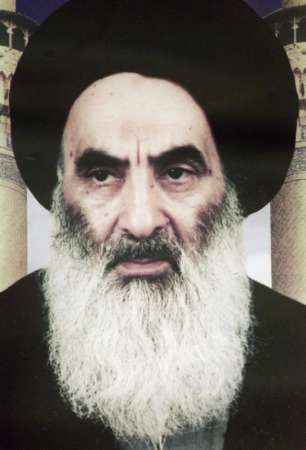
In Beyond Belief: Islamic Excursions Among the Converted Peoples, VS Naipaul looks at some of the social results of polygamy, in Pakistan, and notes that the marriages tend to be serial. The man moves on, 'religiously tomcatting away'; and the consequence is a society of 'half-orphans'. Divorce is in any case unarduous: 'a man who wanted to get rid of his wife could accuse her of adultery and have her imprisoned'. It is difficult to exaggerate the sexualisation of Islamist governance, even among the figures we think of as moderate. Type in 'sex' and 'al-Sistani', and prepare yourself for a cataract of pedantry and smut.

As the narrative opens, Ayed is very concerned about the state of his marriages. But there's a reason for that. When Ayed was a little boy, in the early Eighties, his dad, a talented poppy-farmer, left Waziristan with his family and settled in Greeley, Colorado. This results in a domestic blow to Ayed's self-esteem. Back home in Waziristan, a boy of his age would be feeling a lovely warm glow of pride, around now, as he realises that his sisters, in one important respect, are just like his mother: they can't read or write either. In America, though, the girls are obliged to go to school. Before Ayed knows it, the women have shed their veils, and his sisters are being called on by gum-chewing kaffirs. Now puberty looms.

There is almost an entire literary genre given over to sensibilities such as Sayyid Qutb's. It is the genre of the unreliable narrator - or, more exactly, the transparent narrator, with his helpless giveaways. Typically, a patina of haughty fastidiousness strives confidently but in vain to conceal an underworld of incurable murk. In The Unknown Known I added to this genre, and with enthusiasm. I had Ayed stand for hours in a thicket of nettles and poison ivy, beneath an elevated walkway, so that he could rail against the airiness of the summer frocks worn by American women and the shameless brevity of their underpants. I had him go out in all weathers for evening strolls, strolls gruellingly prolonged until, with the help of a buttress or a drainpipe, he comes across a woman 'quite openly' undressing for bed. Meanwhile, his sisters are all dating. The father and the brothers discuss various courses of action, such as killing them all; but America, bereft of any sense of honour, would punish them for that. The family bifurcates; Ayed returns to the rugged borderland, joins 'the "Prism"', and courts his quartet of nine-year-old sweethearts.

As Ayed keeps telling all his temporary wives, 'My wives don't understand me.' And they don't; indeed, they all want divorces, and for the same embarrassing reason. With his paradigm-shift attack on America now in ruins, and facing professional and social disgrace, Ayed suddenly sees how, in one swoop, he can redeem himself - and secure his place in history with an unknown unknown which is sure to succeed. For this he will be needing a belt

Two years ago I came across a striking photograph in a news magazine: it looked like a crudely cross-sectioned watermelon, but you could make out one or two humanoid features half-submerged in the crimson pulp. It was in fact the bravely circularised photograph of the face of a Saudi newscaster who had been beaten by her husband. In an attempted murder, it seems: at the time of his arrest he had her in the trunk of his car, and was evidently taking her into the desert for interment. What had she done to bring this on herself? In the marital home, that night, the telephone rang and the newscaster, a prosperous celebrity in her own right, answered it. She had answered the telephone. Male Westerners will be struck, here, by a dramatic cultural contrast. I know that I, for one, would be far more likely to beat my wife to death if she hadn't answered the telephone. But customs and mores vary from country to country, and you cannot reasonably claim that one ethos is 'better' than any other.

In 1949 Greeley was dry... It has been seriously suggested, by serious commentators, that suicide-mass murderers are searching for the simplest means of getting a girlfriend. It may be, too, that some of them are searching for the simplest means of getting a drink. Although alcohol, like extramarital sex, may be strictly forbidden in life, there is, in death, no shortage of either. As well as the Koranic virgins, 'as chaste', for the time being, 'as the sheltered eggs of ostriches', there is also a 'gushing fountain' of white wine (wine 'that will neither pain their heads nor take away their reason'). The suicide-mass murderer can now raise his brimming 'goblet' to an additional reward: he has the power, post mortem, to secure paradisal immortality for a host of relations (the number is a round 70, two fewer, curiously, than the traditional allotment of houris). Nor is this his only service to the clan, which, until recently, could expect an honorarium of $20,000 from Iraq, plus $5,000 from Saudi Arabia - as well as the vast prestige automatically accorded to the family of a martyr. And then there is the enticement, or incitement, of peer-group prestige.

Suicide-mass murder is astonishingly alien, so alien, in fact, that Western opinion has been unable to formulate a rational response to it. A rational response would be something like an unvarying factory siren of unanimous disgust. But we haven't managed that. What we have managed, on the whole, is a murmur of dissonant evasion. Paul Berman's best chapter, in Terror and Liberalism, is mildly entitled 'Wishful Thinking' - and Berman is in general a mild-mannered man. But this is a very tough and persistent analysis of our extraordinary uncertainty. It is impossible to read it without cold fascination and a consciousness of disgrace. I felt disgrace, during its early pages, because I had done it too, and in print, early on. Contemplating intense violence, you very rationally ask yourself, what are the reasons for this? And compassionately frowning newscasters are still asking that same question. It is time to move on. We are not dealing in reasons because we are not dealing in reason.

After the failure of Oslo, and the attendant consolidation of Hamas, the second intifada ('earthquake') got under way in 2001, not with stonings and stabbings, like the first, but with a steady campaign of suicide-mass murder. 'All over the world,' writes Berman, 'the popularity of the Palestinian cause did not collapse. It increased.' The parallel process was the intensive demonisation of Israel (academic ostracism, and so on); every act of suicide-mass murder 'testified' to the extremity of the oppression, so that 'Palestinian terror, in this view, was the measure of Israeli guilt'. And when Sharon replaced Barak, and the expected crackdown began, and the Israeli army, with 23 casualties of its own, killed 52 Palestinians in the West Bank city of Jenin, the attack 'was seen as a veritable Holocaust, an Auschwitz, or, in an alternative image, as the Middle Eastern equivalent of the Wehrmacht's assault on the Warsaw Ghetto. These tropes were massively accepted, around the world. Typing in the combined names of "Jenin" and "Auschwitz"... I came up with 2,890 references; and, typing in "Jenin" and "Nazi", I came up with 8,100 references. There were 63,100 references to the combined names of "Sharon" and "Hitler".' Once the redoubled suppression had taken hold, the human bombings decreased; and world opinion quietened down. The Palestinians were now worse off than ever, their societal gains of the Nineties 'flattened by Israeli tanks'. But the protests 'rose and fell in tandem with the suicide bomb attacks, and not in tandem with the suffering of the Palestinian people'.

This was because suicide-mass murder presented the West with a philosophical crisis. The quickest way out of it was to pretend that the tactic was reasonable, indeed logical and even admirable: an extreme case of 'rationalist naivete', in Berman's phrase. Rationalist naivete was easier than the assimilation of the alternative: that is to say, the existence of a pathological cult. Berman assembles many voices. And if we are going to hear the rhetoric of delusion and self-hypnosis, then we might as well hear it from a Stockholm Laureate - the Portuguese novelist Jose Saramago. Again erring on the side of indulgence, Berman is unnecessarily daunted by the pedigree of Saramago's prose, which is in fact the purest and snootiest bombast (you might call it Nobelese). Here he focuses his lofty gaze on the phenomenon of suicide-mass murder:

'Ah, yes, the horrendous massacres of civilians caused by the so-called suicide terrorists... Horrendous, yes, doubtless; condemnable, yes, doubtless, but Israel still has a lot to learn if it is not capable of understanding the reasons that can bring a human being to turn himself into a bomb.'

Palestinian society has channelled a good deal of thought and energy into the solemnisation of suicide-mass murder, a process which begins in kindergarten. Naturally, one would be reluctant to question the cloudless piety of the Palestinian mother who, having raised one suicide-mass murderer, expressed the wish that his younger brother would become a suicide-mass murderer too. But the time has come to cease to respect the quality of her 'rage' - to cease to marvel at the unhingeing rigour of Israeli oppression, and to start to marvel at the power of an entrenched and emulous ideology, and a cult of death. And if oppression is what we're interested in, then we should think of the oppression, not to mention the life-expectancy (and, God, what a life), of the younger brother. There will be much stopping and starting to do. It is painful to stop believing in the purity, and the sanity, of the underdog. It is painful to start believing in a cult of death, and in an enemy that wants its war to last for ever.

Suicide-mass murder is more than terrorism: it is horrorism. It is a maximum malevolence. The suicide-mass murderer asks his prospective victims to contemplate their fellow human being with a completely new order of execration. It is not like looking down the barrel of a gun. We can tell this is so, because we see what happens, sometimes, when the suicide-mass murderer isn't even there - as in the amazingly summary injustice meted out to the Brazilian Jean Charles de Menezes in London. An even more startling example was the rumour-ignited bridge stampede in Baghdad (31 August 2005). This is the superterror inspired by suicide-mass murder: just whisper the words, and you fatally trample a thousand people. And it remains an accurate measure of the Islamists' contortion: they hold that an act of lethal self-bespatterment, in the interests of an unachievable 'cause', brings with it the keys to paradise. Sam Harris, in The End of Faith: Religion, Terror, and the Future of Reason, stresses just how thoroughly and expeditiously the suicide-mass murderer is 'saved'. Which would you prefer, given belief?

'... martyrdom is the only way that a Muslim can bypass the painful litigation that awaits us all on the Day of Judgment and proceed directly to heaven. Rather than spend centuries mouldering in the earth in anticipation of being resurrected and subsequently interrogated by wrathful angels, the martyr is immediately transported to Allah's garden...'

Osama bin Laden's table talk, at Tarnak Farms in Afghanistan, where he trained his operatives before September 2001, must have included many rolling paragraphs on Western vitiation, corruption, perversion, prostitution, and all the rest. And in 1998, as season after season unfolded around the president's weakness for fellatio, he seemed to have good grounds for his most serious miscalculation: the belief that America was a softer antagonist than the USSR (in whose defeat, incidentally, the 'Arab Afghans' played a negligible part). Still, a sympathiser like the famously obtuse 'American Taliban' John Walker Lindh, if he'd been there, and if he'd been a little brighter, might have framed the following argument.

Now would be a good time to strike, John would tell Osama, because the West is enfeebled, not just by sex and alcohol, but also by 30 years of multicultural relativism. They'll think suicide bombing is just an exotic foible, like shame-and-honour killings or female circumcision. Besides, it's religious, and they're always slow to question anything that calls itself that. Within days of our opening outrage, the British royals will go on the road for Islam, and stay on it. And you'll be amazed by how long the word Islamophobia, as an unanswerable indictment, will cover Islamism too. It'll take them years to come up with the word they want - and Islamismophobia clearly isn't any good. Even if the Planes Operation succeeds, and thousands die, the Left will yawn and wonder why we waited so long. Strike now. Their ideology will make them reluctant to see what it is they confront. And it will make them slow learners.

By the summer of 2005, suicide-mass murder had evolved. In Iraq, foreign jihadis, pilgrims of war, were filing across the borders to be strapped up with explosives and nails and nuts and bolts, often by godless Baathists with entirely secular aims - to be primed like pieces of ordnance and then sent out the same day to slaughter their fellow Muslims. Suicide-mass murder, in other words, had passed through a phase of decadence and was now on the point of debauchery. In a single month (May), there were more human bombings in Iraq than during the entire intifada. And this, on 25 July, was the considered response of the Mayor of London to the events of 7 July:

'Given that they don't have jet planes, don't have tanks, they only have their bodies to use as weapons. In an unfair balance, that's what people use.'

I remember a miserable little drip of a poem, c2002, that made exactly the same case. No, they don't have F-16s. Question: would the Mayor like them to have F-16s? And, no, their bodies are not what 'people' use. They are what Islamists use. And we should weigh, too, the spiritual paltriness of such martyrdoms. 'Martyr' means witness. The suicide-mass murderer witnesses nothing - and sacrifices nothing. He dies for vulgar and delusive gain. And on another level, too, the rationale for 'martyrdom operations' is a theological sophistry of the blackest cynicism. Its aim is simply the procurement of delivery systems.

Our ideology, which is sometimes called Westernism, weakens us in two ways. It weakens our powers of perception, and it weakens our moral unity and will. As Harris puts it:

'Sayyid Qutb, Osama bin Laden's favourite philosopher, felt that pragmatism would spell the death of American civilisation... Pragmatism, when civilisations come clashing, does not appear likely to be very pragmatic. To lose the conviction that you can actually be right - about anything - seems a recipe for the End of Days chaos envisioned by Yeats: when "the best lack all conviction, while the worst are full of passionate intensity".'

The opening argument we reach for now, in explaining any conflict, is the argument of moral equivalence. No value can be allowed to stand in stone; so we begin to question our ability to identify even what is malum per se. Prison beatings, too, are evil in themselves, and so is the delegation of torture, and murder, to less high-minded and (it has to be said) less hypocritical regimes. In the kind of war that we are now engaged in, an episode like Abu Ghraib is more than a shameful deviation - it is the equivalent of a lost battle. Our moral advantage, still vast and obvious, is not a liability, and we should strengthen and expand it. Like our dependence on reason, it is a strategic strength, and it shores up our legitimacy.

There is another symbiotic overlap between Islamist praxis and our own, and it is a strange and pitiable one. I mean the drastic elevation of the nonentity. In our popularity-contest culture, with its VIP ciphers and meteoric mediocrities, we understand the attractions of baseless fame - indeed, of instant and unearned immortality. To feel that you are a geohistorical player is a tremendous lure to those condemned, as they see it, to exclusion and anonymity. In its quieter way, this was perhaps the key component of the attraction of Western intellectuals to Soviet Communism: 'join', and you are suddenly a contributor to planetary events. As Muhammad Atta steered the 767 towards its destination, he was confident, at least, that his fellow town-planners, in Aleppo, would remember his name, along with everybody else on earth. Similarly, the ghost of Shehzad Tanweer, as it watched the salvage teams scraping up human remains in the rat-infested crucible beneath the streets of London, could be sure that he had decisively outsoared the fish-and-shop back in Leeds. And that other great nothingness, Osama bin Laden - he is ever-living.

In July 2005 I flew from Montevideo to New York - and from winter to summer - with my six-year-old daughter and her eight-year-old sister. I drank a beer as I stood in the check-in queue, a practice not frowned on at Carrasco (though it would certainly raise eyebrows at, say, the dedicated Hajj terminal in Tehran's Mehrabad); then we proceeded to Security. Now I know some six-year-old girls can look pretty suspicious; but my youngest daughter isn't like that. She is a slight little blonde with big brown eyes and a quavery voice. Nevertheless, I stood for half an hour at the counter while the official methodically and solemnly searched her carry-on rucksack - staring shrewdly at each story-tape and crayon, palpating the length of all four limbs of her fluffy duck.

There ought to be a better word than boredom for the trance of inanition that weaved its way through me. I wanted to say something like, 'Even Islamists have not yet started to blow up their own families on aeroplanes. So please desist until they do. Oh yeah: and stick to people who look like they're from the Middle East.' The revelations of 10 August 2006 were 13 months away. And despite the exposure and prevention of their remarkably ambitious bloodbath of the innocent (the majority of them women and children), the (alleged) Walthamstow jihadis did not quite strive in vain. The failed to promote terror, but they won a great symbolic victory for boredom: the banning of books on the seven-hour flight from England to America.

My daughters and I arrived safely in New York. In New York, at certain subway stations, the police were searching all the passengers, to thwart terrorism - thus obliging any terrorist to walk the couple of blocks to a subway station where the police weren't searching all the passengers. And I couldn't defend myself from a vision of the future; in this future, riding a city bus will be like flying El Al. In the guilty safety of Long Island I watched the TV coverage from my home town, where my other three children live, where I will soon again be living with all five. There were the Londoners, on 8 July, going to work on foot, looking stiff and watchful, and taking no pleasure in anything they saw. Eric Hobsbawm got it right in the mid-Nineties, when he said that terrorism was part of the atmospheric 'pollution' of Western cities. It is a cost-efficient programme. Bomb New York and you pollute Madrid; bomb Madrid and you pollute London; bomb London and you pollute Paris and Rome, and repollute New York. But there was the solace given us by the Mayor. No, we should not be surprised by the use of this sempiternal ruse de guerre. Using their bodies is what people do.

The age of terror, I suspect, will also be remembered as the age of boredom. Not the kind of boredom that afflicts the blasé and the effete, but a superboredom, rounding out and complementing the superterror of suicide-mass murder. And although we will eventually prevail in the war against terror, or will reduce it, as Mailer says, to 'a tolerable level' (this phrase will stick, and will be used by politicians, with quiet pride), we haven't got a chance in the war against boredom. Because boredom is something that the enemy doesn't feel. To be clear: the opposite of religious belief is not atheism or secularism or humanism. It is not an 'ism'. It is independence of mind - that's all. When I refer to the age of boredom, I am not thinking of airport queues and subway searches. I mean the global confrontation with the dependent mind.

One way of ending the war on terror would be to capitulate and convert. The transitional period would be an unsmiling one, no doubt, with much stern work to be completed in the city squares, the town centres, and the village greens. Nevertheless, as the Caliphate is restored in Baghdad, to much joy, the surviving neophytes would soon get used to the voluminous penal code enforced by the Ministry for the Promotion of Virtue and the Suppression of Vice. It would be a world of perfect terror and perfect boredom, and of nothing else - a world with no games, no arts, and no women, a world where the only entertainment is the public execution. My middle daughter, now aged nine, still believes in imaginary beings (Father Christmas, the Tooth Fairy); so she would have that in common, at least, with her new husband. (Continues)